

This list of shark quiz questions will help you dive deep into the world of shark? Whether you’re a marine biology enthusiast or just love these apex predators, this trivia list has everything you think you know about the ocean’s apex hunters.
From easy shark trivia questions perfect for beginners to hard shark trivia questions that’ll stump even experts, there are over a 100 engaging shark trivia questions and answers that will make you the ultimate shark expert! Plus there are fun guess the shark trivia questions and a shark true and false option too!
Let’s begin!
Round 1: Easy Shark Trivia Questions
Let’s start with some warm-up questions that cover the basics of shark biology and behavior.
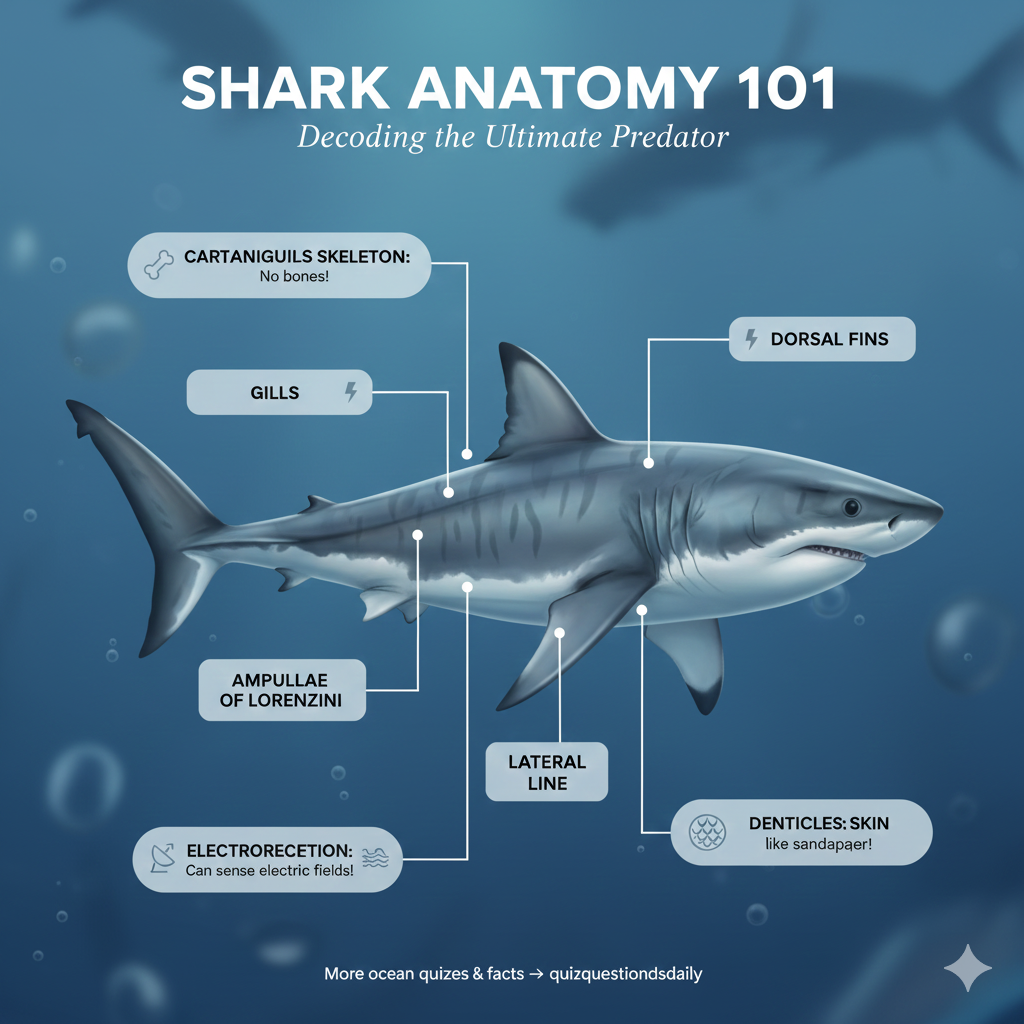
1. How many bones do sharks have in their bodies? A) 206 B) 50 C) 0 D) 100
Answer: C) 0
2. What is the largest species of shark? A) Whale Shark B) Great White Shark C) Hammerhead Shark D) Tiger Shark
Answer: A) Whale Shark
3. How many species of sharks are there approximately? A) 200 B) 1,000 C) 50 D) 500
Answer: D) 500
4. Can sharks swim backwards? A) Only when hunting B) No, they cannot C) Only certain species D) Yes, easily
Answer: B) No, they cannot
5. What color is shark blood? A) Red B) Blue C) Clear D) Green
Answer: A) Red
6. How many rows of teeth can a shark have? A) 20–30 B) 3–5 C) 5–15 D) 1–2
Answer: C) 5–15
7. What is a group of sharks called? A) A school B) A pod C) A pack D) A shiver
Answer: D) A shiver
8. Do sharks have eyelids? A) No, they have no eyelids B) Some species do C) Only when sleeping D) Yes, just like humans
Answer: B) Some species do
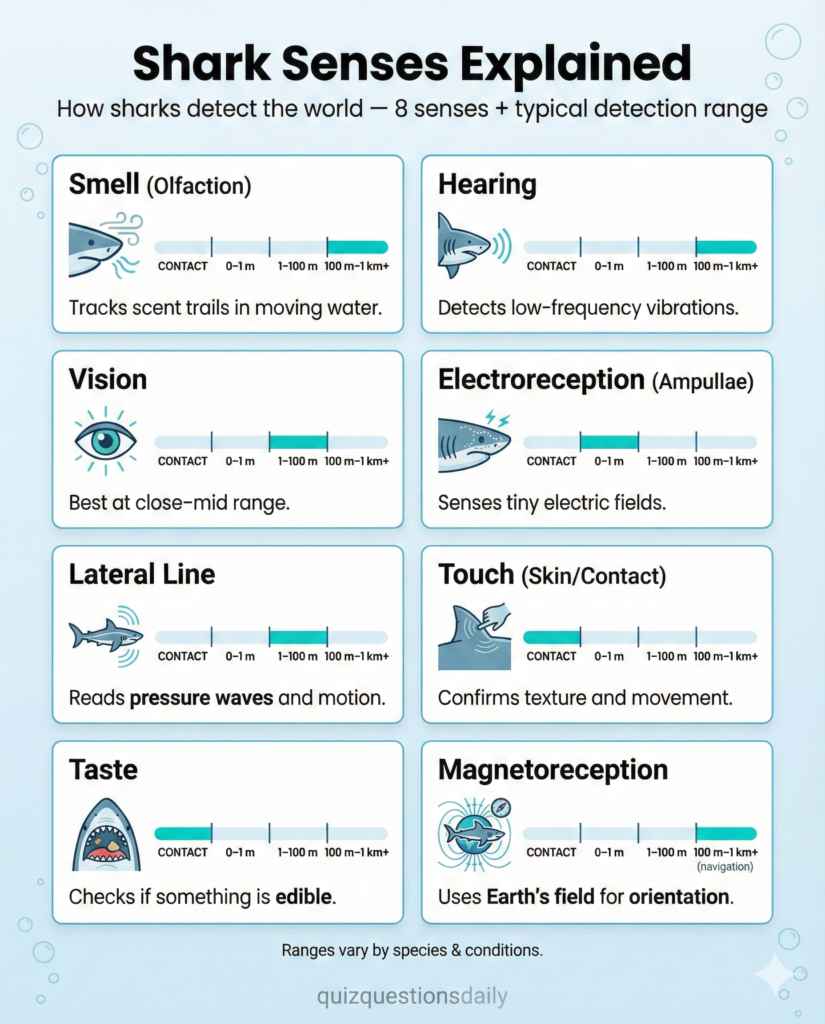
9. What sense do sharks rely on most to detect prey? A) Electroreception B) Smell C) Sight D) Hearing
Answer: A) Electroreception

10. How long can sharks live? A) Exactly 50 years B) 20–30 years C) Varies widely by species D) 10–20 years
Answer: C) Varies widely by species
11. Are all sharks carnivores? A) Most are filter feeders B) Yes, all sharks eat meat C) Some are omnivores D) No, some are herbivores
Answer: B) Yes, all sharks eat meat
12. What is the smallest shark species? A) Cookie Cutter Shark B) Pygmy Shark C) Spined Pygmy Shark D) Dwarf Lantern Shark
Answer: D) Dwarf Lantern Shark
13. How fast can the fastest shark swim? A) 60 mph B) 31 mph C) 15 mph D) 45 mph
Answer: A) 60 mph
14. Do sharks sleep? A) Yes, like humans B) Only during winter C) They rest but don’t sleep like we do D) No, they never sleep
Answer: C) They rest but don’t sleep like we do
15. What percentage of shark attacks on humans are fatal? A) 50% B) 25% C) Over 75% D) Less than 10%
Answer: D) Less than 10%
16. Can sharks detect blood in the water? A) Only certain species B) Yes, from miles away C) Only when very close D) No, this is a myth
Answer: B) Yes, from miles away
17. What temperature water do most sharks prefer? A) It varies by species B) Freezing cold C) Warm tropical waters D) All sharks prefer cold water
Answer: A) It varies by species
18. How do sharks breathe? A) Through their skin B) Through lungs C) They hold their breath D) Through gills
Answer: D) Through gills
19. What is the gestation period for most sharks? A) 9–12 months, similar to humans B) 1–3 months C) It varies widely D) 6–12 months
Answer: C) It varies widely
20. Are sharks mammals or fish? A) Mammals B) Fish C) Amphibians D) Reptiles
Answer: B) Fish
21. How many senses do sharks have? A) 6 B) 7 C) 5 D) 8
Answer: D) 8
22. What is shark skin made of? A) Tiny tooth-like structures B) Smooth scales C) Bone plates D) Regular fish scales
Answer: A) Tiny tooth-like structures
23. Can sharks get cancer? A) No, they’re immune B) Only in captivity C) Yes, they can D) Only certain species
Answer: C) Yes, they can
24. How many gill slits do most sharks have? A) 10 B) 5–7 C) 3 D) 2
Answer: B) 5–7
25. What is the lifespan of a great white shark? A) 40–50 years B) 20–30 years C) 100+ years D) 70+ years
Answer: D) 70+ years
Round 2: Medium Difficulty Shark Trivia Questions
Feeling the heat? Let’s amp up the difficulty with these tougher shark trivia questions!
26. Which shark species is known for its unique hammer-shaped head? A) Bonnethead Shark B) Bull Shark C) Both Hammerhead Shark and Bonnethead Shark D) Hammerhead Shark
Answer: C) Both Hammerhead Shark and Bonnethead Shark
27. What do sharks use their liver for besides digestion? A) Temperature regulation B) Buoyancy control C) Storing vitamins D) Nothing special
Answer: B) Buoyancy control
28. Which shark is known for being able to survive in freshwater? A) Bull Shark B) Tiger Shark C) Great White D) Mako Shark
Answer: A) Bull Shark
29. What is unique about the cookie cutter shark’s hunting method? A) It uses venom B) It hunts in packs C) It takes circular bites from larger animals D) It swallows prey whole
Answer: C) It takes circular bites from larger animals
30. How do mother sharks give birth? A) All give live birth B) They don’t reproduce C) All lay eggs D) It varies by species
Answer: D) It varies by species
31. What is the purpose of a shark’s lateral line? A) Detecting vibrations and movement B) Swimming straight C) Attracting mates D) Storing energy
Answer: A) Detecting vibrations and movement
32. Which shark species is bioluminescent? A) Tiger Shark B) Lantern Shark C) Hammerhead D) Great White
Answer: B) Lantern Shark
33. What is the deepest-dwelling shark species? A) Frilled Shark B) Megamouth Shark C) Great White D) Portuguese Dogfish
Answer: D) Portuguese Dogfish
34. How many hearts does a shark have? A) 3 B) 4 C) 2 D) 1
Answer: C) 2
35. What is the spiral valve intestine in sharks used for? A) Filtering water B) Increasing surface area for digestion C) Swimming D) Storing food
Answer: B) Increasing surface area for digestion
36. Which shark has the most powerful bite force? A) Bull Shark B) Tiger Shark C) Great White D) Megalodon (extinct)
Answer: D) Megalodon (extinct)
37. What is unique about the thresher shark’s tail? A) It can regenerate B) It glows in the dark C) It’s extremely long and used like a whip D) It’s poisonous
Answer: C) It’s extremely long and used like a whip
38. How do sharks maintain their body temperature? A) Through constant swimming B) They hibernate C) They’re warm-blooded D) Most are cold-blooded
Answer: D) Most are cold-blooded
39. Which shark is nicknamed “the garbage can of the sea”? A) Nurse Shark B) Tiger Shark C) Great White D) Bull Shark
Answer: B) Tiger Shark
40. How many fins does a typical shark have? A) 3 B) 5 C) 10 D) 6–8
Answer: D) 6–8
41. What is the goblin shark’s most distinctive feature? A) Its spot B) Its speed C) Its size D) Its pink color and protruding jaw
Answer: D) Its pink color and protruding jaw
42. Which shark species is known for vertical migration? A) Tiger Shark B) Whale Shark C) Lantern Sharks D) Great White
Answer: C) Lantern Sharks
43. What percentage of a shark’s brain is dedicated to smell? A) 50% B) 10% C) 70% D) 33%
Answer: C) 70%
44. How do nurse sharks breathe while stationary? A) Through their skin B) They can’t breathe when still
C) They hold their breath D) Through buccal pumping
Answer: D) Through buccal pumping
45. What is the walking shark known for? A) Flying B) Jumping out of water C) Using its fins to “walk” on the ocean floor D) Swimming on its back
Answer: C) Using its fins to “walk” on the ocean floor
46. What caused the extinction of Megalodon? A) Asteroid impact B) Disease C) Climate change and prey extinction D) Hunting by humans
Answer: C) Climate change and prey extinction
47. Which shark has biofluorescence that only other sharks can see? A) Swell Shark B) Tiger Shark C) Whale Shark D) Great White
Answer: A) Swell Shark
48. How do sharks detect their prey’s heartbeat? A) Through touch B) They cannot C) Through electroreception D) Through hearing
Answer: C) Through electroreception
49. What is unique about the frilled shark? A) It lives in rivers B) It’s the fastest shark C) It’s herbivorous D) It’s considered a “living fossil”
Answer: D) It’s considered a “living fossil”
50. How long is the longest recorded migration by a shark? A) 1,000 miles B) 12,400 miles C) 5,000 miles D) 20,000 miles
Answer: D) 20,000 miles
Round 3: Hard Shark Trivia Questions
51. What is the scientific order that includes all sharks? A) Cetacea B) Selachimorpha C) Chondrichthyes D) Osteichthyes
Answer: B) Selachimorpha
52. How many ampullae of Lorenzini does a hammerhead shark have? A) 500 B) 100 C) Over 3,000 D) 3,000
Answer: D) 3,000
53. What is the gestation period of a frilled shark? A) 3.5 years B) 9 months C) 1 year D) 2 years
Answer: A) 3.5 years
54. What causes the phenomenon called “tonic immobility” in sharks? A) Bright lights B) Cold water C) Flipping them upside down D) Loud noises
Answer: C) Flipping them upside down
55. Which extinct shark was larger than Megalodon? A) Otodus chubutensis B) Leedsichthys C) Helicoprion D) None
Answer: D) None
56. What is the function of the nictitating membrane in some shark species? A) Protection of the eye during attacks B) Enhanced night vision C) Water filtration D) Temperature regulation
Answer: A) Protection of the eye during attacks
57. How many chromosomes do great white sharks have? A) 46 pairs B) 41 pairs C) 23 pairs D) 52 pairs
Answer: B) 41 pairs
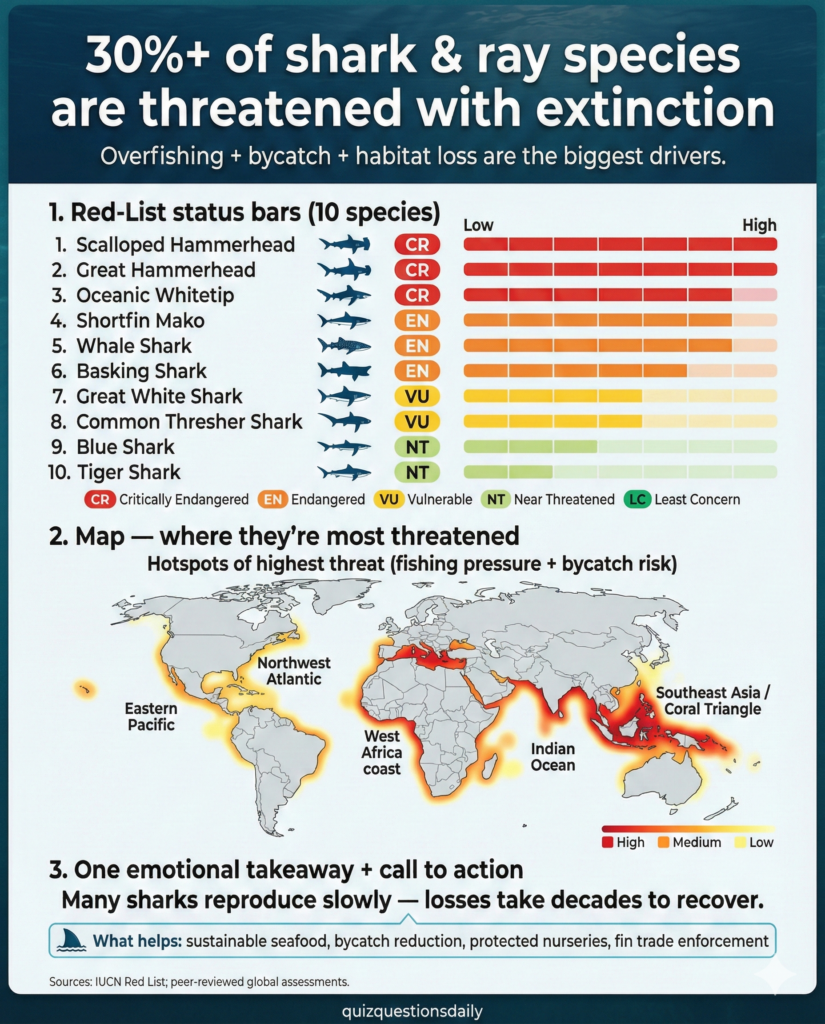
58. What percentage of ocean shark and ray species are threatened with extinction? A) 10% B) 50% C) Over 30% D) 20%
Answer: C) Over 30%
59. What is the purpose of countershading in sharks? A) Attracting mates B) Communication C) Temperature regulation D) Camouflage from above and below
Answer: D) Camouflage from above and below
60. How many taste buds does a shark have? A) About 10 B) 10,000 C) None D) 100–1,000
Answer: A) About 10
61. What adaptation allows Greenland sharks to survive in near-freezing water? A) Thick blubber B) Antifreeze proteins in their blood C) High metabolism D) Hibernation
Answer: B) Antifreeze proteins in their blood
62. What is the porbeagle shark’s unique characteristic? A) It has venom B) It can jump 20 feet out of water C) Regional endothermy D) It can change colors
Answer: C) Regional endothermy
63. How do wobbegong sharks hunt? A) Ambush with camouflage B) Pack hunting C) Speed pursuit D) Paralyzing venom
Answer: A) Ambush with camouflage
64. What is the average pH level of shark blood? A) 6.8 B) 8.0 C) 5.0 D) 7.4
Answer: D) 7.4
65. Which shark species practices intrauterine cannibalism? A) Great White B) Sand Tiger Shark C) Whale Shark D) Nurse Shark
Answer: B) Sand Tiger Shark
66. What is the function of dermal denticles beyond protection? A) Hearing enhancement B) Attracting prey C) Reducing drag and increasing swim efficiency D) Temperature sensing
Answer: C) Reducing drag and increasing swim efficiency
67. How do angel sharks capture prey? A) Pack hunting B) High-speed chases C) Using lures D) Lying flat on the ocean floor and ambushing
Answer: D) Lying flat on the ocean floor and ambushing
68. What is the retia mirabile in sharks? A) A heat exchange system B) A digestive enzyme C) A sensory organ D) A mating organ
Answer: A) A heat exchange system
69. How many vertebrae does a typical shark have? A) 100–150 B) 33 C) 200–300 D) 500+
Answer: C) 200–300
70. What is the purpose of urea retention in sharks? A) Waste removal B) Maintaining osmotic balance with seawater C) Communication D) Energy storage
Answer: B) Maintaining osmotic balance with seawater
71. Which shark has the highest known testosterone levels of any animal? A) Tiger Shark B) Mako Shark C) Great White D) Bull Shark
Answer: D) Bull Shark
72. What is the megamouth shark’s primary food source? A) Krill and jellyfish B) Fish C) Squid D) Seals
Answer: A) Krill and jellyfish
73. How do sharks’ immune systems differ from humans? A) They have no immune system B) They rely solely on skin protection C) They produce unique antibodies D) They’re identical to human immunity
Answer: C) They produce unique antibodies
74. What percentage of a shark’s body weight is muscle? A) 80% B) Up to 60% C) 40% D) 25%
Answer: B) Up to 60%
75. Which shark has been recorded at the greatest depth? A) Greenland Shark B) Bluntnose Sixgill C) Gulper Shark D) Portuguese Dogfish
Answer: D) Portuguese Dogfish
76. What is unique about bamboo shark reproduction? A) Females can store sperm for months B) They reproduce asexually C) Males carry the eggs D) They clone themselves
Answer: A) Females can store sperm for months
77. How does the basking shark filter feed? A) Suction feeding B) Ram feeding with open mouth C) Using tentacles D) Using baleen plates
Answer: B) Ram feeding with open mouth
78. What causes the distinctive scarring pattern on some sharks? A) Fighting B) Parasites C) Cookie cutter shark bites D) All of the above
Answer: D) All of the above
79. How many species of hammerhead sharks exist? A) 9 B) 6 C) 12 D) 3
Answer: A) 9
80. What is the maximum dive depth recorded for a great white shark? A) 5,000 feet B) 1,200 feet C) 4,000 feet D) 500 feet
Answer: C) 4,000 feet
Round 4: Guess The Shark!
Can you identify these sharks based on their unique characteristics?
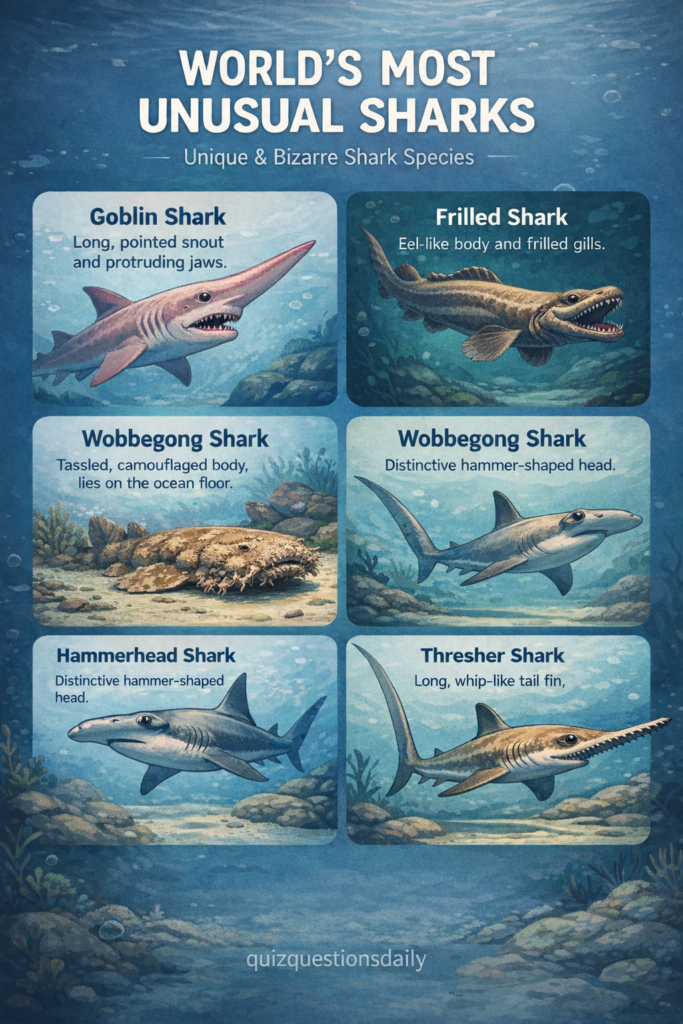
1. I have a long, saw-like snout with teeth protruding from both sides. I use it to slash through schools of fish. What am I?
Answer: Sawshark (not sawfish, which actually belongs to the ray family)
🦈 Fun Fact: When baby sawsharks are born, their ‘teeth’ are covered in a sheath to protect the mother when she’s giving birth.
2. I’m often mistaken for a rock or piece of coral. I have tasseled lobes around my mouth that help me blend in perfectly with the reef floor. Prey swim right over me before I strike! What shark am I?
Answer: Wobbegong (Carpet Shark)
🦈 Fun Fact: The name “wobbegong” comes from an Australian Aboriginal word meaning “shaggy beard”. Pretty cool name origin if you ask me!
3. I glow bright blue-green in the dark depths where I live. I’m small, growing only about 8 inches long, making me one of the tiniest sharks in the ocean. What am I?
Answer: Dwarf Lantern Shark – The smallest shark in the world! They use bioluminescence to attract prey and possibly communicate.
🦈 Fun Fact: Dwarf Lantern sharks are the smallest sharks in the world.
4. My tail is as long as my entire body, sometimes longer! I use it like a whip to stun schools of fish before eating them. Fishermen often catch me because my spectacular tail gets tangled in nets. What shark am I?
Answer: Thresher Shark
🦈 Fun Fact: There are three species: common thresher, bigeye thresher, and pelagic thresher. Their tails can grow up to 10 feet long.
5. I look like something from prehistoric times with my eel-like body and 300 needle-sharp teeth arranged in 25 rows. I have six gill slits instead of five, and I’ve remained virtually unchanged for 80 million years. What am I?
Answer: Frilled Shark
🦈 Fun Fact: This living fossil doesn’t even look like the usual shark, but rather more like a sea serpent.
Round 5: True or False Shark Trivia Questions and Answers
Let’s separate shark facts from fiction with these myth-busting scenarios!
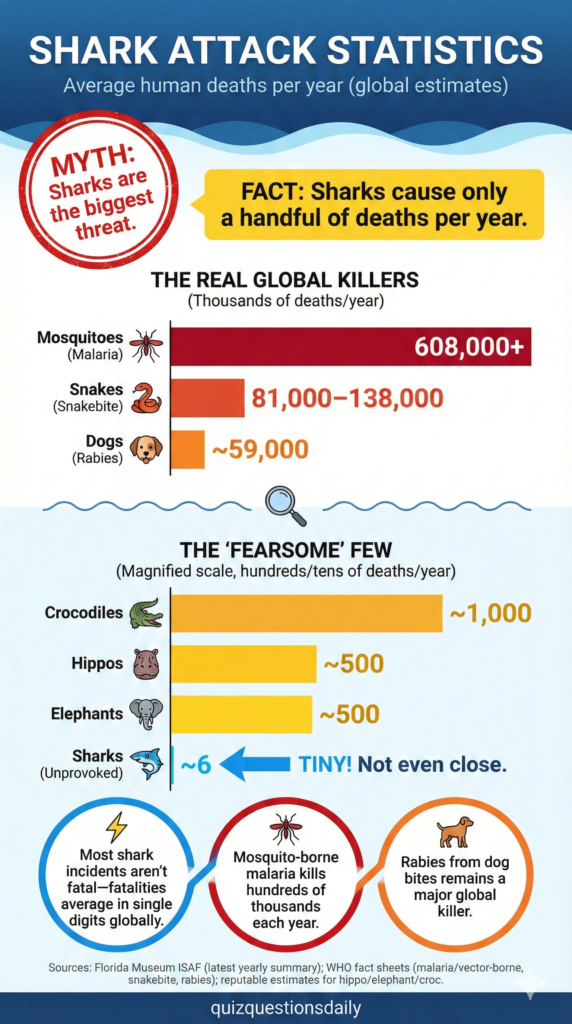
1. SCENARIO: You’re swimming in the ocean and cut your finger. Your friend panics and says a shark will smell the blood from miles away and attack within minutes. Is this fear justified?
TRUE or FALSE: Sharks will immediately attack if they smell human blood in the water.
Answer: FALSE
The Reason: This is a huge myth that sharks attack immediately if they smell your blood in water. In reality, while they detect your blood from miles away, they aren’t attracted to human blood that much. Rather, studies show that sharks prefer fish blood. Plus sharks prefer to investigate first and most shark attacks happen when the sharks mistake you for a seal or something else.
2. SCENARIO: A documentary claims that sharks are perfect predators that never get sick or develop cancer. A pharmaceutical company wants to use shark cartilage as a miracle cure. Should you believe this?
TRUE or FALSE: Sharks are immune to all diseases and never get cancer.
Answer: FALSE
The Reason: This myth has caused millions of sharks to die because people want to harvest them for bogus cancer treatments. Sharks DO in fact get cancer, tumors, and various diseases. Research has found at least 23 different tumor types in sharks and rays.
3. SCENARIO: You’re on a boat when your phone falls in the water. Your captain says to leave it because sharks are attracted to the electromagnetic fields from electronics and might attack. Should you worry?
TRUE or FALSE: Sharks are attracted to electronic devices and will attack people using them in the water.
Answer: PARTIALLY TRUE
The Reason: Sharks ARE attracted to electromagnetic fields from electronics, but this doesn’t make them attack. They investigate out of curiosity, not aggression. Sharks use electroreception to find prey, and electronics can confuse this sense. However, they quickly lose interest when they realize it’s not food.
4. SCENARIO: Your dive instructor tells you that if you punch a shark in the nose during an attack, it will immediately leave you alone. Can you rely on this advice?
TRUE or FALSE: Punching a shark in the nose is the best defense strategy.
Answer: PARTIALLY FALSE
The Reason: While it is true that the nose is sensitive, the EYES and GILLS are even better targets. The nose advice is very popular but I don’t recommend it because you might end up missing and putting your hand right in its mouth. Instead gouge their eyes or gills if you have to do something.
5. SCENARIO: A friend refuses to swim at dusk because they heard that sharks only hunt during dawn and dusk. Are they right to be concerned?
TRUE or FALSE: Sharks only hunt during dawn and dusk.
Answer: FALSE
The Reason: This reasoning usually applies to some species like the great whites. In reality, the sharks hunt 24/7 depending on species with a lot of species are active midday, while some deep-sea are active in constant darkness.
6. SCENARIO: You read online that all sharks must keep swimming or they’ll die because they can’t breathe when still. Your friend points out a nurse shark resting motionless on the ocean floor. Who’s right?
TRUE or FALSE: All sharks will die if they stop swimming.
Answer: FALSE
The Reason: Again, this only applies to certain species (like great whites and makos) that use “ram ventilation” and must swim to push water over their gills. Many sharks like nurse sharks, wobbegongs, and angel sharks can actively pump water over their gills using buccal pumping, allowing them to rest on the ocean floor.
7. SCENARIO: A marine biologist tells you that great white sharks are actually warm-blooded like mammals, which is why they’re such effective hunters. Is this accurate?
TRUE or FALSE: Great white sharks are warm-blooded animals.
Answer: PARTIALLY TRUE
The Reason: Great whites have “regional endothermy,” meaning they can keep certain body parts (like muscles and organs) warmer than the surrounding water, but they’re not fully warm-blooded like mammals. Quick fun fact, only five shark species have regional endothermy: great white, mako, salmon shark, porbeagle, and thresher sharks.
8. SCENARIO: Your diving instructor says that if you stay completely still in the water, sharks won’t be able to detect you because they hunt by sensing movement. Can you trust this advice?
TRUE or FALSE: Sharks can only detect prey that is moving.
Answer: FALSE
The Reason: Sharks have multiple sensory systems (8 senses). So even if you’re perfectly still, they can detect you through electroreception (sensing your heartbeat and muscle contractions), smell, and their lateral line system (detecting pressure changes). Staying still might help a little, but doesn’t make you invisible like in the movies.
9. SCENARIO: A nature show claims that shark skin is so rough it was once used as sandpaper, and that touching it can cause severe injuries. Should you be terrified of accidentally brushing against a shark?
TRUE or FALSE: Shark skin was historically used as sandpaper and can seriously injure humans.
Answer: TRUE
The Reason: Shark skin (called shagreen) was indeed used as sandpaper. The dermal denticles make it extremely rough. In fact, if you rub it from tail to head, it can cause painful abrasions. However, if you stroke from head to tail (the direction the denticles point), it feels relatively smooth.
10. SCENARIO: You hear that female sharks are larger and more aggressive than males in most species. Your friend says this is sexist stereotyping. What’s the truth?
TRUE or FALSE: Female sharks are typically larger than males in most species.
Answer: TRUE
The Reason: In the majority of shark species, females are indeed larger than males. This is because females need more body mass to carry developing embryos. However, the “more aggressive” part is not scientifically supported. Rather, aggression depends on the shark itself and the situation, not sex.
Frequently Asked Questions
1. What are some fun shark trivia questions?
That depends on what you think of as fun. If you ask me, the Guess the Shark is always a great way to open up and even the scenario true or false shark trivia is another way to break up the monotony in between questions.
2. Where can I use these shark trivia questions?
These questions are great for trivia nights, for teachers to teach kids more about these predators, on the 8th of June (World Ocean Day) to raise awareness etc.
3. Is there a free downloadable shark trivia questions pdf?
Of course! I love free pdfs myself because they’re so convenient so I try to include them in every article myself.
Free Downloadable Shark Trivia Questions
Check Out Our Other Apex Predators
We love all our apex predators, not just sharks. And if you do too, then there are plenty of other quiz questions and trivia for you to check out.
- Orcas: How can we talk about sharks and not mention orcas? Check out orca quiz questions here.
- Snake: Similar to sharks, snakes have been around for millions of years, and are plenty of fun!
- Bear quiz questions: Looking for something beyond the sea? Well, this one features our favorite furry mammal!