

Wolves have always been surrounded by mystery, power, and a whole lot of misunderstandings. We often picture them howling at the moon or roaming snowy forests, but there’s so much more to these incredible animals than what we see in movies or storybooks.
These intelligent predators live in tightly-bonded packs where every wolf has a job to do — from hunting together with military-level teamwork to raising pups as a family. Whether you’re fascinated by the gray wolf, curious about wolf communication, or just want to learn what separates a wolf from a regular dog, this quiz has everything covered.
Use these wolf quiz questions for school trivia, wildlife lessons, game nights, or just to test yourself for fun. Ready to see how much you really know about wolves? Let’s begin!
🎈Round 1: Fun Wolf Quiz Questions for Kids
1. What is a group of wolves called? A) A pack B) A herd C) A flock D) A pride
Answer: A) A pack
2. What sound do wolves make to communicate over long distances? A) They bark B) They meow C) They howl D) They chirp
Answer: C) They howl
🐺 Fun Fact: A wolf’s howl can be heard up to 10 miles away in open terrain.
3. What do baby wolves eat when they’re first born? A) Meat immediately B) Their mother’s milk C) Berries D) Fish
Answer: B) Their mother’s milk
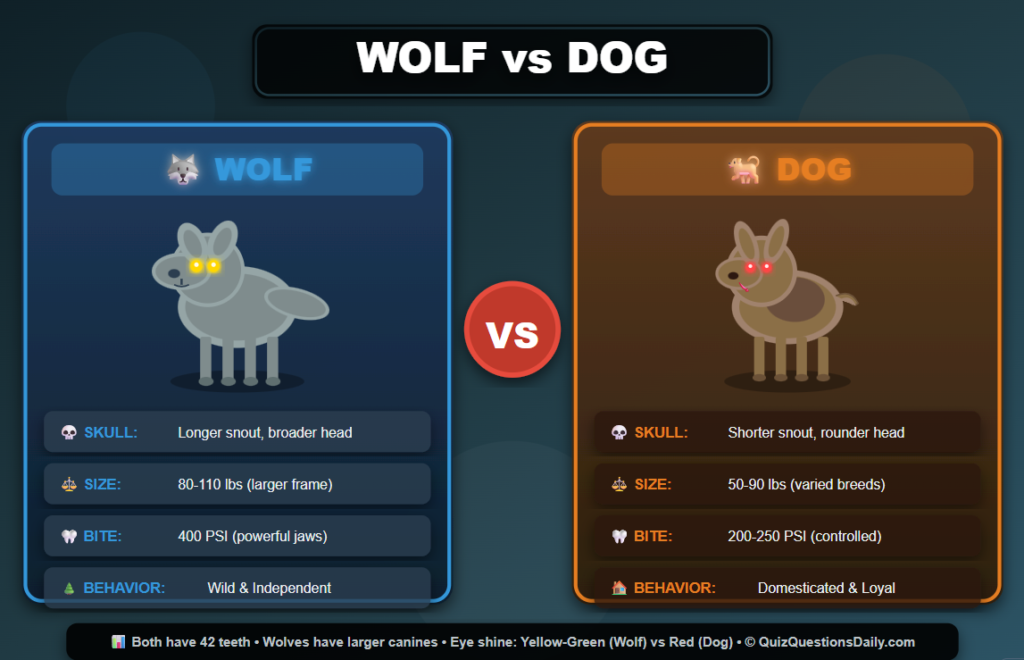
4. Are wolves related to dogs? A) Yes, dogs descended from wolves B) No, they’re completely different C) Only some dog breeds D) Dogs came first
Answer: A) Yes, dogs descended from wolves
5. What color are most wolf pups’ eyes when born? A) Golden from birth B) Blue, changing to yellow/amber later C) Green D) Red
Answer: B) Blue, changing to yellow/amber later
6. How do wolves greet each other in their pack? A) They shake paws B) They lick faces and nuzzle C) They ignore each other D) They fight
Answer: B) They lick faces and nuzzle
7. What do wolves use their tails for? A) Just decoration B) To show their feelings and communicate C) To swat flies D) Nothing special
Answer: B) To show their feelings and communicate
8. Can wolves swim? A) No, they sink B) Only in winter C) Yes, they’re good swimmers D) Only baby wolves can
Answer: C) Yes, they’re good swimmers
9. What is a baby wolf called? A) A cub B) A kitten C) A pup D) A joey
Answer: C) A pup
10. How many toes does a wolf have on each front paw? A) Three B) Four C) Five D) Six
Answer: C) Five
11. What helps wolves stay warm in winter? A) They wear coats B) Two layers of thick fur C) They migrate south D) They hibernate
Answer: B) Two layers of thick fur
🐺 Fun Fact: Wolf fur is so warm they can survive in temperatures as low as -40°F.
12. What is the main role of a wolf pack? A) To fight other animals B) To work together for hunting, protection, and raising pups C) To migrate across oceans D) To store food for winter
Answer: B) To work together for hunting, protection, and raising pups
13. What do wolves mostly eat? A) Plants and vegetables B) Large animals like deer and elk C) Only fish D) Berries
Answer: B) Large animals like deer and elk
14. How do wolf pups learn to hunt? A) They know from birth B) By playing and watching adults C) They read books D) They never hunt
Answer: B) By playing and watching adults
15. What helps wolves find their way back home? A) GPS devices B) Their excellent sense of smell C) They get lost often D) Following stars only
Answer: B) Their excellent sense of smell
16. Can wolves see in the dark? A) No, they’re blind at night B) Yes, they have great night vision C) Only during full moons D) They use flashlights
Answer: B) Yes, they have great night vision
17. What’s special about a wolf’s nose? A) It glows B) It can smell things 100 times better than humans C) It changes colors D) Nothing special
Answer: B) It can smell things 100 times better than humans
18. How fast can wolves run? A) 5 mph B) 15 mph C) 36-38 mph D) 100 mph
Answer: C) 36-38 mph
19. Where do wolves make their home? A) In nests in trees B) In dens underground or in caves C) In the ocean D) They don’t have homes
Answer: B) In dens underground or in caves
20. Do wolves like to play? A) Never, they’re too serious B) Yes, especially when young C) Only once a year D) They don’t know how
Answer: B) Yes, especially when young
21. What body part helps wolves balance when running? A) Their ears B) Their nose C) Their tail D) Their whiskers
Answer: C) Their tail
22. How do wolves show they’re the leader? A) By holding their tail and head high B) They wear a crown C) By hiding D) By running away
Answer: A) By holding their tail and head high
23. What do wolves drink? A) Soda B) Milk their whole lives C) Water D) Juice
Answer: C) Water
24. Are wolves bigger than pet dogs? A) No, dogs are bigger B) They’re exactly the same size C) Yes, most wolves are bigger D) Only sometimes
Answer: C) Yes, most wolves are bigger
25. What season are wolf pups usually born? A) Winter B) Summer C) Spring D) Fall
Answer: C) Spring
26. How do wolves mark their territory? A) With paint B) With scent and scratching C) They don’t D) With flags
Answer: B) With scent and scratching
27. Can wolves climb trees? A) Yes, all the time B) No, they’re not good climbers C) Only backwards D) Better than cats
Answer: B) No, they’re not good climbers
28. What color can wolf fur be? A) Only gray B) Gray, white, black, brown, or mixed C) Only black D) Pink and purple
Answer: B) Gray, white, black, brown, or mixed
29. How many wolves are usually in a pack? A) Always 2 B) 100 or more C) Usually 5-10 wolves D) Just 1
Answer: C) Usually 5-10 wolves
30. Do wolves help each other? A) Never B) Yes, they work together as a family C) Only on Sundays D) They fight constantly
Answer: B) Yes, they work together as a family
🧩Round 2: Wolf Quiz Questions Medium Difficulty
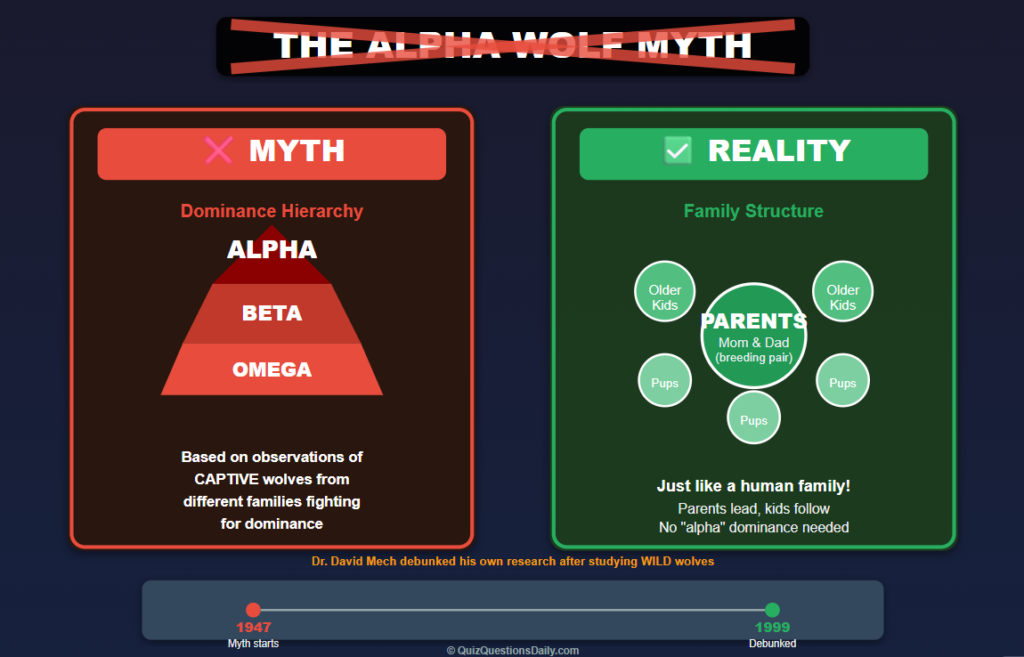
31. What is the “alpha wolf” concept in modern wolf research? A) Completely accurate B) A myth; packs are family units led by parents C) Only applies to wild wolves D) Only males can be alphas
Answer: B) A myth; packs are family units led by parents
🐺 Fun Fact: The scientist who popularized “alpha wolf” later ended up debunking his own theory but I don’t think the rest of us got the memo.
32. How far can a wolf travel in a single day? A) 1-2 miles B) 5 miles C) Up to 30-40 miles D) 100 miles
Answer: C) Up to 30-40 miles
33. What is the average size of a wolf’s territory? A) 1 square mile B) 10 square miles C) 50-1,000 square miles depending on prey D) They don’t have territories
Answer: C) 50-1,000 square miles depending on prey
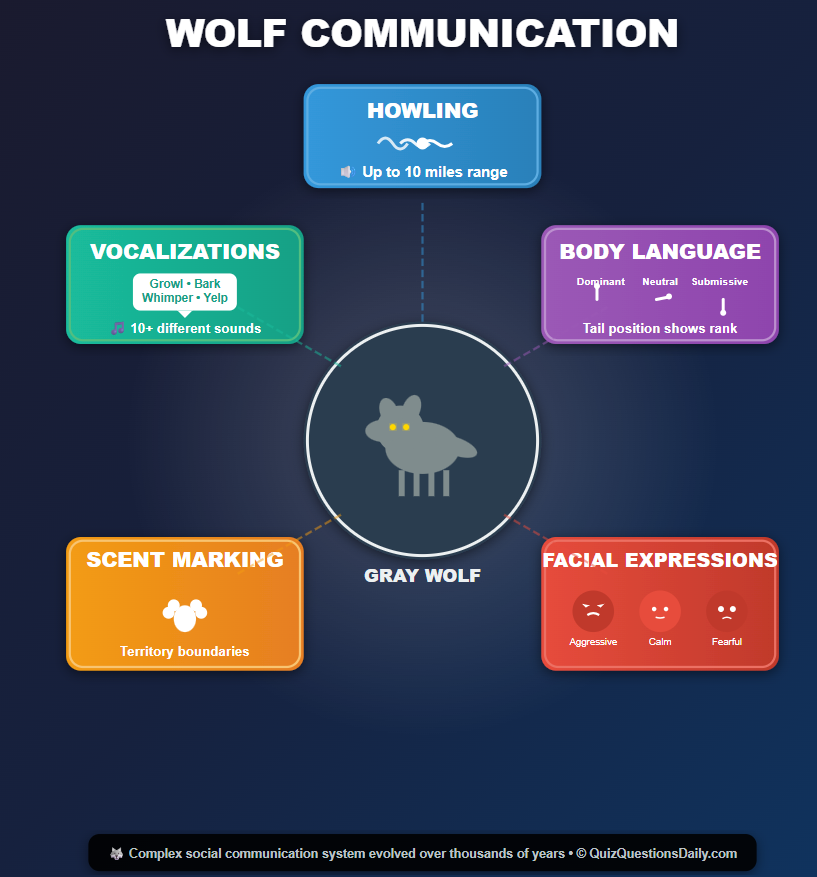
34. How many different vocalizations can wolves make? A) Just howling B) 3-4 sounds C) Over 10 distinct sounds D) They’re silent animals
Answer: C) Over 10 distinct sounds
35. What is the gestation period for wolves? A) 40 days B) 63 days C) 100 days D) 6 months
Answer: B) 63 days
36. How does a wolf’s skull differ from a dog’s? A) No difference B) Wolves have larger skulls, longer snouts, and bigger teeth C) Dogs have bigger skulls D) Only the color differs
Answer: B) Wolves have larger skulls, longer snouts, and bigger teeth
37. What role do “omega” wolves play in a pack? A) They’re the strongest fighters B) Often the lowest-ranking, may reduce tension C) They lead hunts D) This role doesn’t exist in wild packs
Answer: D) This role doesn’t exist in wild packs
38. How many wolf pups are typically born in a litter? A) 1-2 pups B) 4-6 pups C) 15 pups D) Always 10
Answer: B) 4-6 pups
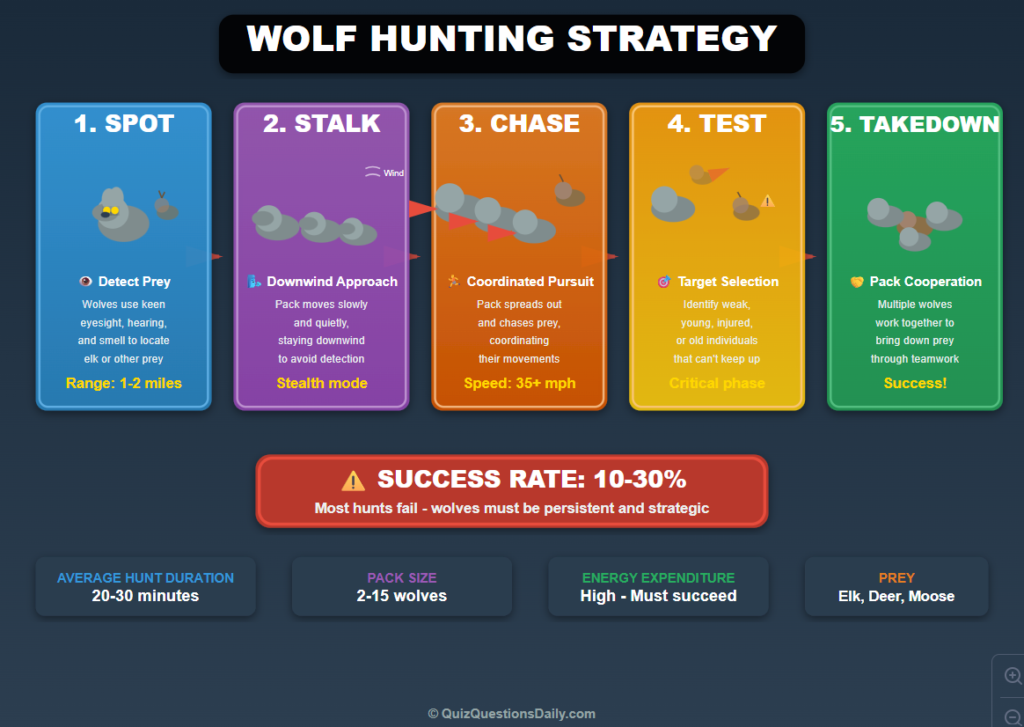
39. What hunting strategy do wolves primarily use? A) Solo ambush B) Coordinated pack hunting to exhaust prey C) They don’t hunt D) Setting traps
Answer: B) Coordinated pack hunting to exhaust prey
40. When were dogs first domesticated from wolves? A) 100 years ago B) 1,000 years ago C) 15,000-40,000 years ago D) 100,000 years ago
Answer: C) 15,000-40,000 years ago
41. What is the bite force of a wolf? A) 100 PSI B) 400 PSI (about twice a dog’s) C) 50 PSI D) 1000 PSI
Answer: B) 400 PSI (about twice a dog’s)
42. How do wolves communicate their position in the pack? A) By wearing badges B) Through body language, ear position, and tail carriage C) They don’t show rank D) Only through fighting
Answer: B) Through body language, ear position, and tail carriage
43. What is the primary cause of wolf mortality?A) Old age B) Disease C) Conflicts with other wolves and humans D) Natural disasters
Answer: C) Conflicts with other wolves and humans
44. How much can an adult wolf eat in one meal? A) 2 pounds B) 5 pounds C) Up to 20 pounds D) 50 pounds
Answer: C) Up to 20 pounds
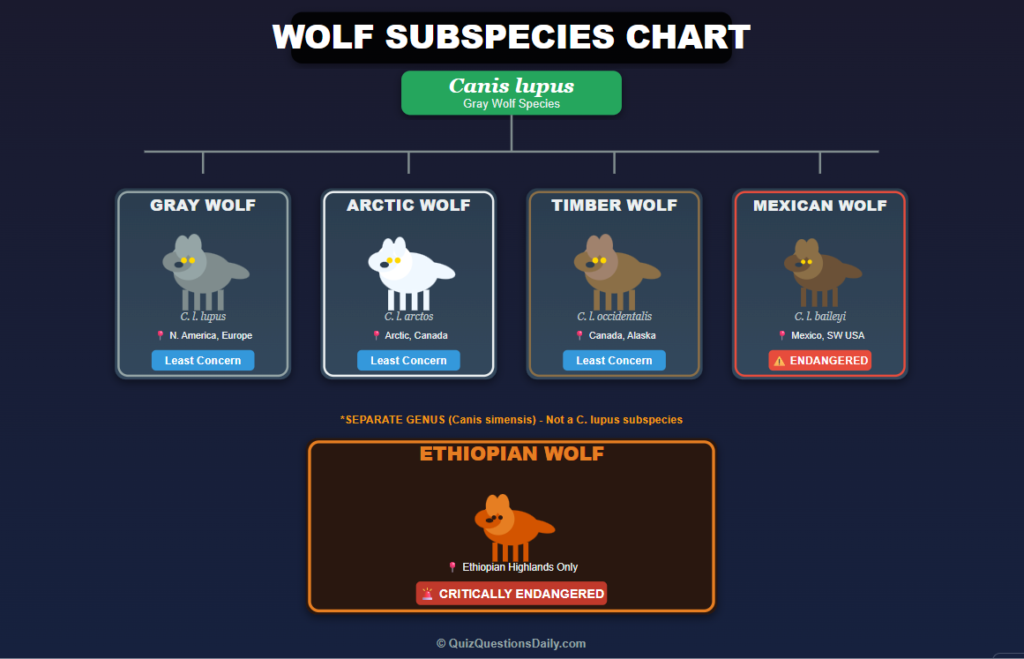
45. What subspecies of wolf lives in the Arctic? A) Gray wolf B) Arctic wolf C) Timber wolf D) Red wolf
Answer: B) Arctic wolf
46. How long do wolf pups stay with their parents? A) 2 months B) 6 months C) 1-3 years D) Their whole lives always
Answer: C) 1-3 years
47. What makes wolves a “keystone species”? A) They’re not important B) They control prey populations and shape entire ecosystems C) They’re the biggest animal D) They live near water
Answer: B) They control prey populations and shape entire ecosystems
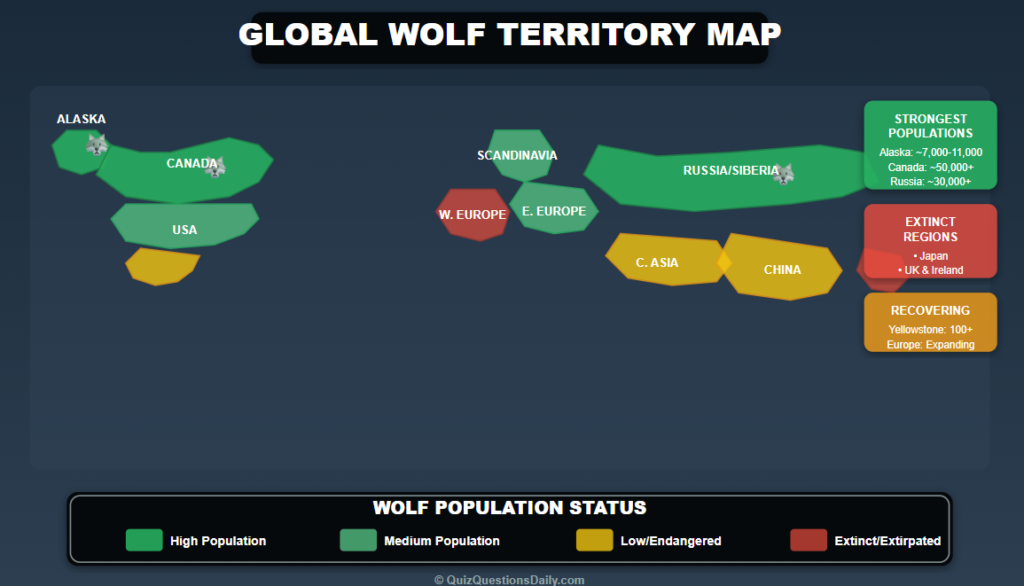
48. Where in North America are gray wolves most common? A) Florida B) Texas C) Alaska, Canada, and parts of the Northern Rockies D) California only
Answer: C) Alaska, Canada, and parts of the Northern Rockies
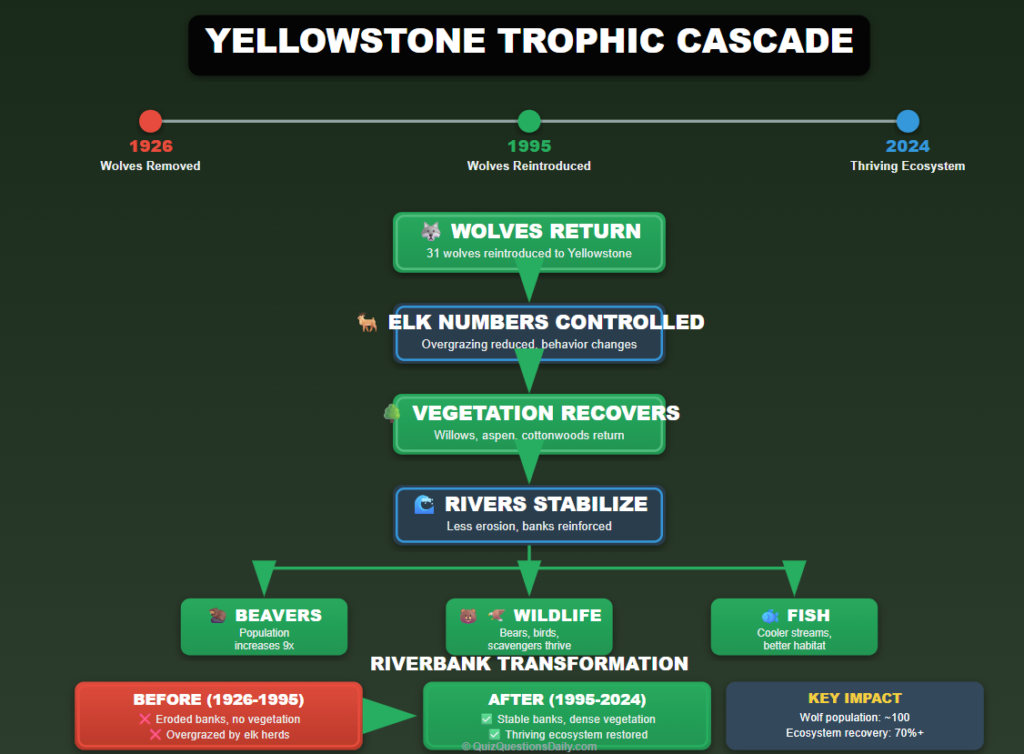
49. What happened when wolves were reintroduced to Yellowstone in 1995? A) Nothing changed B) The ecosystem rebalanced, vegetation recovered C) All elk disappeared D) It failed completely
Answer: B) The ecosystem rebalanced, vegetation recovered
🐺 Fun Fact: Wolves even changed the course of rivers by altering elk behavior
50. What part of a large animal do wolves often target to slow it down? A) The tail B) The legs
C) The ears D) The back fur
Answer: B) The legs
51. What is the average lifespan of a wild wolf? A) 2-3 years B) 6-8 years C) 15 years D) 30 years
Answer: B) 6-8 years
52. How do European wolves differ from North American wolves? A) They’re completely different species B) Generally smaller, adapted to different prey C) Exactly the same D) European wolves are bigger
Answer: B) Generally smaller, adapted to different prey
53. What percentage of wolf hunts are successful? A) 90% B) 50% C) 10-30% D) 100%
Answer: C) 10-30%
54. How many teeth does an adult wolf have? A) 20 B) 32 (like humans) C) 42 D) 50
Answer: C) 42
55. What threatens wolf populations today? A) Natural causes only B) Habitat loss, hunting, and human-wildlife conflict C) Other predators D) Nothing, they’re thriving everywhere
Answer: B) Habitat loss, hunting, and human-wildlife conflict
56. How far apart do wolf tracks typically appear when walking? A) 6 inches B) 26-30 inches C) 5 feet D) Right next to each other
Answer: B) 26-30 inches
57. What is unique about Arctic wolves? A) They’re purple B) White fur, shorter ears and snouts for cold adaptation C) They’re the smallest wolves D) They can’t howl
Answer: B) White fur, shorter ears and snouts for cold adaptation
58. At what age do wolf pups usually join their first real hunt? A) 2 months B) 6–8 months C) 2 years D) They never join hunts
Answer: B) 6–8 months
59. What is the conservation status of gray wolves in most of their range? A) Extinct B) Critically endangered everywhere C) Varies by region; endangered in some areas, recovered in others D) Not threatened anywhere
Answer: C) Varies by region; endangered in some areas, recovered in others
60. How much does a large male wolf typically weigh? A) 20-30 pounds B) 50-60 pounds C) 80-110 pounds D) 200 pounds
Answer: C) 80-110 pounds
🏆Round 3: Very Hard Wolf Quiz Questions
61. What is the scientific name for the gray wolf? A) Canis lupus B) Canis familiaris C) Vulpes vulpes D) Panthera leo
Answer: A) Canis lupus
62. How many recognized subspecies of gray wolf exist? A) 2-3 B) Around 38-40 historically recognized C) Over 100 D) Just 1
Answer: B) Around 38-40 historically recognized
63. What is the hearing range frequency of wolves compared to humans? A) The same B) Wolves can hear up to 80 kHz vs human 20 kHz C) Humans hear better D) Wolves are deaf
Answer: B) Wolves can hear up to 80 kHz vs human 20 kHz
64. What genetic percentage do wolves share with domestic dogs? A) 50% B) 75% C) 99.9% identical DNA D) 10%
Answer: C) 99.9% identical DNA
65. What is the trophic cascade effect observed in Yellowstone? A) No effect occurred B) Wolves reduced elk, allowing willows to recover, stabilizing riverbanks C) Only elk were affected D) It only lasted one year
Answer: B) Wolves reduced elk, allowing willows to recover, stabilizing riverbanks
🐺 Fun Fact: This cascade affected everything from beavers to grizzly bears.
66. What is the bite force quotient (BFQ) of wolves? A) 50 B) 136 (higher than most dogs) C) 200 D) 10
Answer: B) 136 (higher than most dogs)
67. How does wolf social intelligence compare to domestic dogs? A) Dogs are far superior B) Wolves show better problem-solving but less human cooperation C) Identical D) Wolves can’t learn
Answer: B) Wolves show better problem-solving but less human cooperation
68. What year were wolves extirpated from Yellowstone before reintroduction? A) 1990 B) 1950 C) 1926 D) 2000
Answer: C) 1926
69. What is the metabolic rate difference between wolves and dogs? A) No difference B) Wolves have faster metabolism requiring more food C) Dogs need more food D) Wolves don’t have metabolism
Answer: B) Wolves have faster metabolism requiring more food
70. How many wolf pups typically survive to adulthood? A) All of them B) About 50% C) Only 1 per litter D) None
Answer: B) About 50%
71. What is the jaw muscle structure difference between wolves and dogs? A) Identical B) Wolves have more developed masseter muscles C) Dogs are stronger D) No jaw muscles in either
Answer: B) Wolves have more developed masseter muscles
72. Where do Iberian wolves primarily live? A) Asia B) North America C) Spain and Portugal D) Australia
Answer: C) Spain and Portugal
73. What is the estimated global wolf population? A) 1,000 B) 10,000 C) 200,000-250,000 D) 1 million
Answer: C) 200,000-250,000
74. How do wolves’ eyes reflect light differently than dogs? A) They don’t B) Wolf eyes glow green/yellow, many dogs glow red C) Wolves’ eyes don’t reflect D) They’re identical
Answer: B) Wolf eyes glow green/yellow, many dogs glow red
75. What is unique about the Ethiopian wolf? A) It’s not actually a wolf (different genus) B) It’s the largest wolf C) It lives underwater D) It doesn’t exist
Answer: A) It’s not actually a wolf (different genus)
76. How long is a wolf’s gestation period compared to similar-sized dogs? A) Much longer B) About the same (63 days) C) Much shorter D) Wolves don’t reproduce
Answer: B) About the same (63 days)
77. What percentage of their body weight do wolves need to eat weekly? A) 5% B) 15-20% C) 50% D) 100%
Answer: B) 15-20%
78. How does pack breeding differ in wild wolves? A) Everyone breeds B) Typically only the breeding pair (parents) reproduce C) No breeding occurs D) Random selection
Answer: B) Typically only the breeding pair (parents) reproduce
79. What is the “founder effect” in Isle Royale wolves? A) No effect B) Severe inbreeding from isolated population C) Population explosion D) New species development
Answer: B) Severe inbreeding from isolated population
🐺 Fun Fact: Isle Royale wolves became the world’s most inbred population.
80. What adaptations allow wolves to survive in diverse climates? A) None, they can’t adapt B) Seasonal coat changes, varied body sizes, behavioral flexibility C) They only live in one climate D) Magic
Answer: B) Seasonal coat changes, varied body sizes, behavioral flexibility
🎬Round 4: Wolves Quiz Questions in Pop Culture
81. In “The Jungle Book,” what is the name of the wolf who raises Mowgli? A) Baloo B) Shere Khan C) Raksha (Mother Wolf) D) Bagheera
Answer: C) Raksha (Mother Wolf)
82. What are the Stark family’s direwolves called in “Game of Thrones“? A) Regular wolves B) Direwolves (extinct giant wolves) C) Werewolves D) Ghost wolves
Answer: B) Direwolves (extinct giant wolves)
83. In the “Twilight” series, what do the Quileute transform into? A) Vampires B) Shape-shifters (wolf form) C) Bears D) Birds
Answer: B) Shape-shifters (wolf form)
84. What is the wolf’s role in “Little Red Riding Hood”? A) The hero B) The villain who disguises himself C) The guide D) Red Riding Hood’s pet
Answer: B) The villain who disguises himself
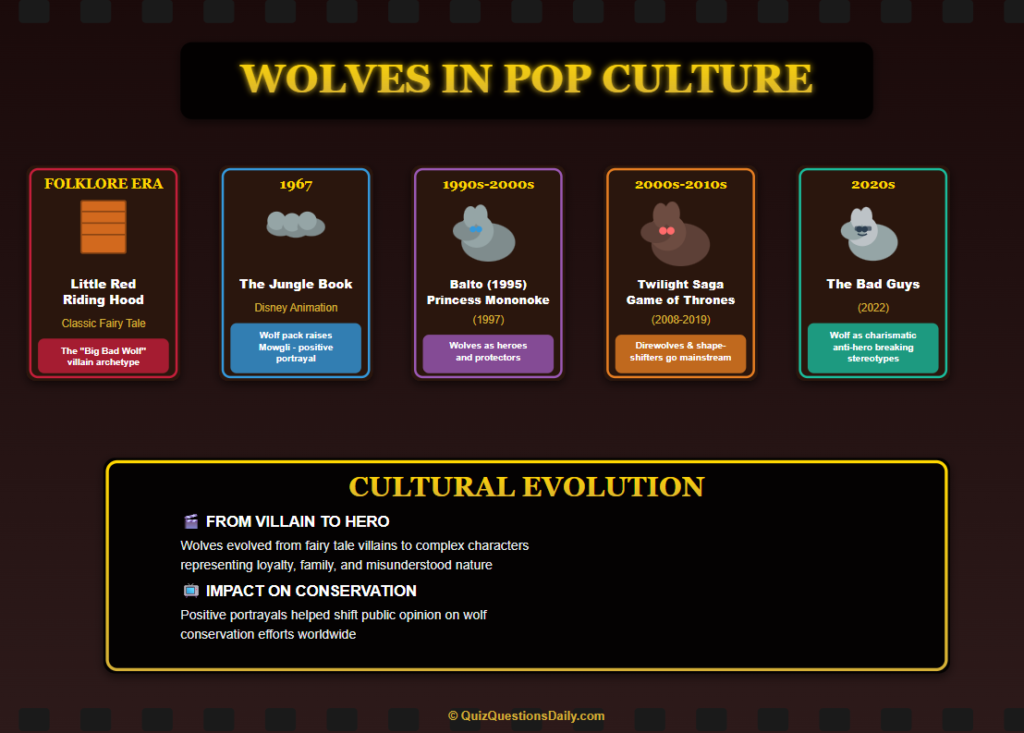
85. In “Princess Mononoke,” what do the wolf gods protect? A) A castle B) The forest C) A village D) Treasure
Answer: B) The forest
🐺 Fun Fact: The wolf goddess Moro represents nature’s fierce protective spirit.
86. What is the wolf character’s name in “The Bad Guys” movie? A) Big Bad Wolf B) Mr. Wolf C) Wolfgang D) Wolfie
Answer: B) Mr. Wolf
87. In “Teen Wolf,” what triggers Scott’s transformation? A) A full moon B) Anger and strong emotions C) Eating meat D) Magic spells
Answer: B) Anger and strong emotions
88. What Native American tribe is associated with wolf legends in “Twilight”? A) Cherokee B) Navajo C) Quileute D) Apache
Answer: C) Quileute
89. Who is the leader of the wolf pack that adopts Mowgli? A) Raksha B) Akela C) Baloo D) Bagheera
Answer: B) Akela
90. In folklore, what can harm a werewolf? A) Water B) Silver C) Gold D) Wood
Answer: B) Silver
91. What breed inspired the direwolves in “Game of Thrones” TV series? A) Huskies B) Northern Inuit Dogs C) German Shepherds D) Wolves
Answer: B) Northern Inuit Dogs
92. Who voices Moro, the wolf goddess in “Princess Mononoke” (English)? A) Meryl Streep B) Gillian Anderson C) Julia Roberts D) Angelina Jolie
Answer: B) Gillian Anderson
93. What is the Big Bad Wolf’s goal in “The Three Little Pigs”? A) To make friends B) To eat the pigs C) To build a house D) To find his family
Answer: B) To eat the pigs
94. In “Frozen,” what animals pull Kristoff’s sled? A) Wolves B) Reindeer C) Dogs D) Bears
Answer: B) Reindeer (though wolves chase them)
95. What type of wolf pack member is Jacob Black in “Twilight”? A) Omega B) Beta, then Alpha C) He never joins D) Just a follower
Answer: B) Beta, then Alpha
96. In “Balto,” what mixed heritage does the hero have? A) Full wolf B) Half-wolf, half-dog C) Full dog D) Part bear
Answer: B) Half-wolf, half-dog
97. What Japanese term refers to the wolf’s extinction in Japan? A) Kaiju B) Kami C) The Japanese wolf (Honshu wolf) extinct since 1905 D) Yokai
Answer: C) The Japanese wolf (Honshu wolf) extinct since 1905
98. What color are most direwolves in “Game of Thrones”? A) All white B) All black C) Various (gray, white, black) D) Blue
Answer: C) Various (gray, white, black)
99. In werewolf legends, what causes the transformation? A) Science experiments B) A bite or curse, often tied to full moons C) Drinking water D) Magic potions only
Answer: B) A bite or curse, often tied to full moons
100. What animated movie features a wolf named Humphrey? A) Balto B) Alpha and Omega C) The Jungle Book D) Brother Bear
Answer: B) Alpha and Omega
🐺 Fun Fact: This movie explores wolf pack dynamics through a romantic comedy lens. You should definitely check it out.
Frequently Asked Questions:
-
What can you learn from this wolf trivia?
Where do I even begin? These wolf quiz questions cover such a wide array like how they shape ecosystems (Question 47), wolf vs dog differences, biology, subspecies, etc. And the best part is that there are plenty of fun infographics too!
-
What are some facts about wolves?
You can find plenty of fun facts scattered throughout these wolf quiz questions. For example, wolves howl up to 10 miles away (Question 2), run 36-38 mph (Question 18), and have smell 100 times better than humans (Question 17). Packs are family units, not “alpha” hierarchies (Question 31). They have 42 teeth with 400 PSI bite force (Questions 54, 41). I could go on and on.
-
How do wolves communicate?
Wolves use sophisticated multi-channel communication and I’ve got plenty of questions related to that. Some of them are that they howl to coordinate packs and mark territory, audible up to 10 miles (Question 2), they produce over 10 distinct vocalizations (Question 34) and rely heavily on body language (Question 42). You can check out your infographic on that.
-
What makes a wolf unique?
I have so many facts about that. Wolves are the only truly social wild canids, living in family packs of 5-10 members (Questions 29, 40). Unlike dogs, they have larger skulls, longer snouts, and superior problem-solving skills (Questions 36, 67). Do explore our wolf quiz questions for more unique wolf facts.
-
Where can I use these wolf quiz questions?
You can use these wolf quiz questions for trivia night, for quizzes related to wildlife enthusiasts, or classroom science lessons, homeschool curricula, nature camps, and family game nights.
Wolf Quiz Questions Free PDF:
Here’s a free PDF with another 100 wolf quiz questions that you can explore and it’s downloadable for your ease of use!
Quizzes Based on Wolves
If you want to test out how much you’ve learned from these wolf quiz questions, don’t forget to check out these quizzes so that you can test yourself in real-time!
- Easy Wolf Quiz for Kids: Perfect for the young ones.
- Hard Wolf Quiz for Adults: This is high on the difficulty and fun scale, designed for adults.
- Wolves in Pop Culture: Perfect for all-ages and family nights.
Related Wildlife Quiz Questions Articles:
Did you have fun with this wolf quiz questions? We’ve got plenty of others as well! Here are a few on other magnificent predators.
- Lion Quiz Questions: You’ll find facts about prides, roars and everything king of beasts.
- Bear Quiz Questions: Love grizzlies and polar bears? You’ll find them and much more here.
- Tiger Quiz Questions: They’re the biggest cats and we’ve tried to do justice to them here.
All of these animals are apex land predators and have such unique characteristics and behaviors that any wildlife enthusiast is bound to fall in love!