

I was chilling at home with a bowl of pasta when the idea for this quiz hit me. Personally, I think that I’m a person who can order spaghetti carbonara without embarrassing myself but that’s the extent of it. But there are probably people out there who can identify 20 pasta shapes blindfolded.
So, I tried to create a quiz that caters to everyone (get the pun?). There are three difficulty levels, controversial hot takes that might start arguments and secret bonus points for the true pasta masters out there.
Scroll carefully, hopefully with a bowl of pasta. Some of the best stuff is hiding in plain sight.
Choose Your Difficulty Path
🍝 NONNA’S KITCHEN (Easy)
“Come, bambino. Let me teach you properly.”
What You’re Getting with these Pasta Quiz Questions and Answers:
- 20 questions, beginner-friendly
- Helpful hints included
- Perfect for casual pasta lovers
Round 1: Pasta Shapes (Questions 1-10)
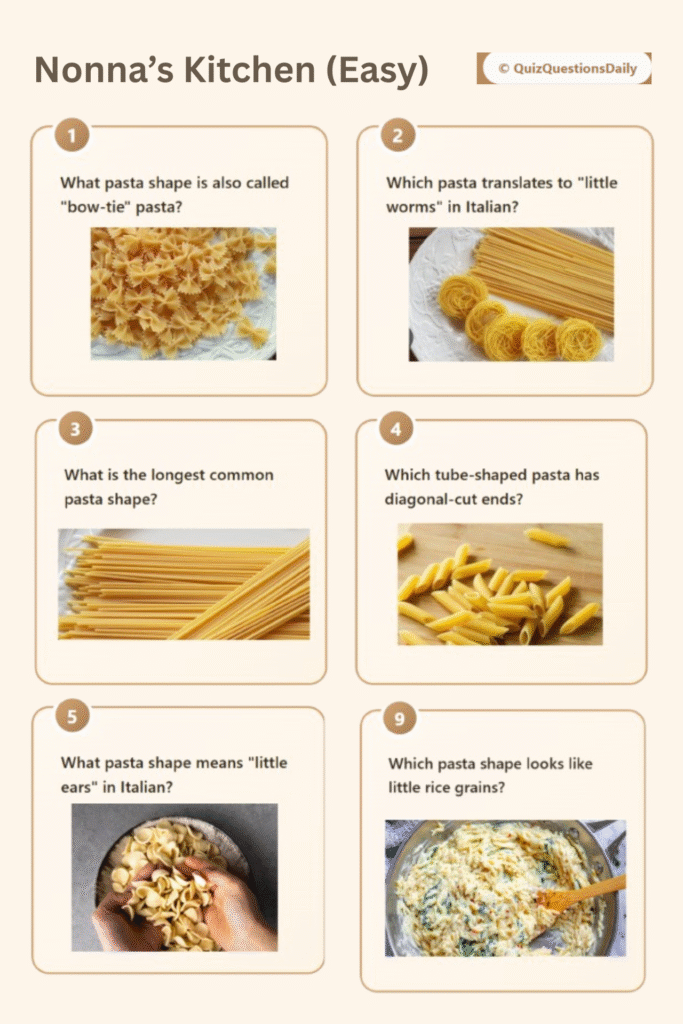
- What pasta shape is also called “bow-tie” pasta?
- Which pasta translates to “little worms” in Italian?
- What is the longest common pasta shape?
- Which tube-shaped pasta has diagonal-cut ends?
- What pasta shape means “little ears” in Italian?
- True or False: Ravioli is a type of stuffed pasta. (This one is a gimme)
- Which pasta is traditionally used in mac and cheese?
- What shape is farfalle pasta?
- Which pasta shape looks like little rice grains?
- Name the flat, wide ribbon pasta often served with Bolognese.
📊 Round 1 Complete! Check Your Answers:
- Farfalle
- Vermicelli
- Spaghetti (though technically bucatini can be longer!)
- Penne
- Orecchiette
- True
- Macaroni (Fun Fact: While macaroni is traditional, any pasta works! Nonna won’t judge. Much.)
- Butterfly/Bow-tie
- Orzo
- Pappardelle
Round 2: Famous Pasta Dishes (Questions 11-20)
“Now let’s see if you actually know what you’re eating at Italian restaurants.”
11. What are the four traditional ingredients in authentic carbonara? (If you say cream, you’re already wrong.)
12. What does “aglio e olio” translate to?
13. Which sauce is traditionally served with fettuccine Alfredo?
14. What pasta dish is named after a famous opera?
15. Which dish features clams, garlic, white wine, and parsley?
16. What does “puttanesca” sauce typically contain?
17. True or False: Traditional Italian meatballs are served ON TOP of spaghetti.
18. Which pasta dish literally means “jump in the mouth”?
19. What sauce is made with tomato, vodka, and cream?
20. Which cheese is traditionally used in authentic carbonara?
📊 Round 2 Complete! Check Your Answers:
11. What are the four traditional ingredients in authentic carbonara? (If you say cream, you’re already wrong.) Eggs, Pecorino Romano, guanciale (cured pork jowl), black pepper (NO CREAM!)
12. What does “aglio e olio” translate to? Garlic and oil
13. Which sauce is traditionally served with fettuccine Alfredo? Butter and Parmesan
💡 Fun Fact: Fettuccine Alfredo is barely known in Italy because it’s basically an American invention.
14. What pasta dish is named after a famous opera? Pasta alla Norma (named after Bellini’s opera “Norma”)
15. Which dish features clams, garlic, white wine, and parsley? Both Spaghetti alle vongole and Linguine with clam sauce
💡 Fun Fact: They’re the same dish but with different names.
16. What does “puttanesca” sauce typically contain? Tomatoes, olives, capers, garlic, anchovies
17. True or False: Traditional Italian meatballs are served ON TOP of spaghetti. False
💡 Fun Fact: In Italy, meatballs (polpette) are served as a separate course, not on pasta. Spaghetti and meatballs together is Italian-American.
18. Which pasta dish literally means “jump in the mouth”? Saltimbocca
19. What sauce is made with tomato, vodka, and cream? Vodka sauce / Penne alla vodka
20. Which cheese is traditionally used in authentic carbonara? Pecorino Romano
💡 Fun Fact: This is a fight-starter in Italian households. Pecorino Romano is the traditional choice, but some Romans use a mix.
Calculate Your Total Score for Nonna’s Kitchen: _/20
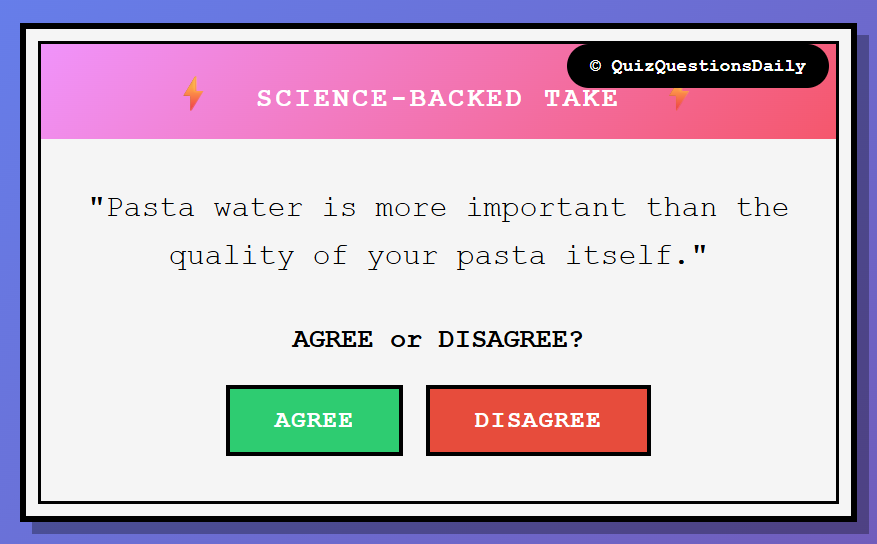
🔥 CONTROVERSIAL HOT TAKE #1
👨🍳 CULINARY SCHOOL (Medium)
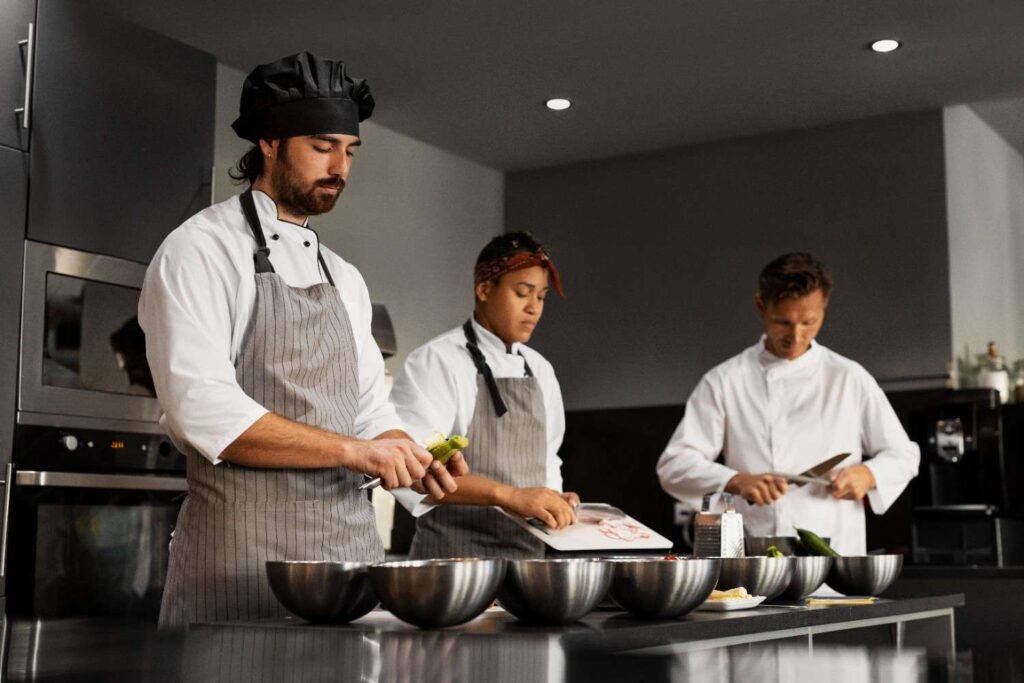
“Step into Culinary School. Are you ready to earn your whites?”
What You’re Getting:
- 30 questions, balanced difficulty
- Some regional deep-cuts
- For serious foodies
Round 1: Advanced Pasta Shapes (Questions 1-12)
Question 1: What is the difference between rigatoni and penne?
Question 2: Which pasta shape was designed to look like radiators? A) Rotelle B) Radiatori C) Casarecce D) Campanelle
Question 3: Fill in the blank: __________ means “priest strangler” in Italian.
Question 4: Name at least 3 types of stuffed pasta.
Question 5: What does “rigate” mean when describing pasta? A) Smooth B) Ridged/grooved C) Small D) Spiral
Question 6: Which pasta shape looks like a wagon wheel?
Question 7: What is the smallest pasta shape called? A) Orzo B) Ditalini C) Acini di pepe D) Pastina
Question 8: Fill in the blank: Gemelli means “___________” in Italian.
Question 9: Which pasta is traditionally made with a wooden comb (pettine)? A) Cavatelli B) Garganelli C) Orecchiette D) Trofie
Question 10: True or False: Bucatini is hollow spaghetti.
Question 11: What does “mostaccioli” literally mean? A) Little mustaches B) Small tubes C) Curved pasta D) Party pasta
Question 12: Name the pasta shape that means “little tongues.”
📊 Round 1 Complete! Check Your Answers:
Question 1: What is the difference between rigatoni and penne? Rigatoni is wider with straight-cut ends and ridges; penne has diagonal cuts and is narrower
Question 2: Which pasta shape was designed to look like radiators? A) Rotelle B) Radiatori C) Casarecce D) Campanelle B) Radiatori
Question 3: Fill in the blank: __________ means “priest strangler” in Italian. Strozzapreti
💡 Fun Fact: Greedy priests ate this pasta so fast they’d choke on it. Dark, but hilarious.
Question 4: Name at least 3 types of stuffed pasta. Possible Answers: Ravioli, tortellini, cappelletti, agnolotti, mezzelune, tortelloni, etc.
Question 5: What does “rigate” mean when describing pasta? A) Smooth B) Ridged/grooved C) Small D) Spiral B) Ridged/grooved
Question 6: Which pasta shape looks like a wagon wheel? Rotelle or Ruote
Question 7: What is the smallest pasta shape called? A) Orzo B) Ditalini C) Acini di pepe ✓ D) Pastina C) Acini di pepe
Question 8: Fill in the blank: Gemelli means “___________” in Italian. Twins
💡 Fun Fact: Because two strands are twisted together!
Question 9: Which pasta is traditionally made with a wooden comb (pettine)? A) Cavatelli B) Garganelli C) Orecchiette D) Trofie B) Garganelli
Question 10: True or False: Bucatini is hollow spaghetti. True
💡 Fun Fact: It’s like spaghetti with a tiny hole running through it.
Question 11: What does “mostaccioli” literally mean? A) Little mustaches B) Small tubes C) Curved pasta D) Party pasta A) Little mustaches
Question 12: Name the pasta shape that means “little tongues.” Linguine
ROUND 2: Regional Italian Pasta & Dialects (Question 13-23)
Question 13: In Roman dialect, what do they call the traditional pasta for Cacio e Pepe? A) Spaghetti B) Tonnarelli C) Bucatini D) Linguine
Question 14: Which region is famous for trofie pasta with pesto?
Question 15: What is “malloreddus” and where is it from?
Question 16: In Puglia, they make orecchiette by hand. What does the traditional cook use to shape them?
Question 17: What is the traditional pasta shape for pasta alla Norma (Sicily)? A) Spaghetti B) Rigatoni C) Penne D) Bucatini
Question 18: In Emilia-Romagna, the traditional way to say ‘handmade pasta’ in dialect is pasta __________.
Question 19: Which pasta shape is traditional in Abruzzo and means “guitar strings”?
Question 20: What is “pici” and which region is it from?
Question 21: In Naples, what do they call the very thin spaghetti that’s thinner than capellini?
Question 22: Every region of Italy has at least one unique pasta shape found nowhere else.
Question 23: What is “fregula” and how is it different from couscous?
📊 Round 2 Complete! Check Your Answers:
Question 13: In Roman dialect, what do they call the traditional pasta for Cacio e Pepe? A) Spaghetti B) Tonnarelli C) Bucatini D) Linguine B) Tonnarelli
💡 Fun Fact: Tonnarelli has a square cross-section (not round like spaghetti), which gives it more surface area to grip the creamy cheese sauce.
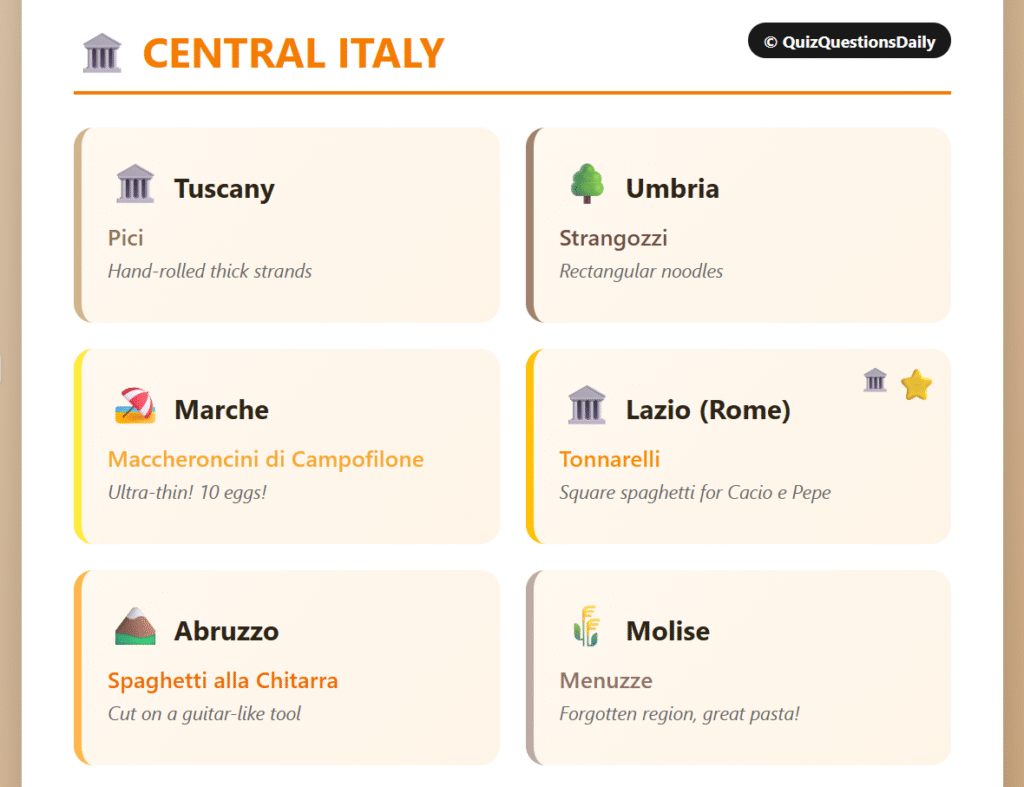
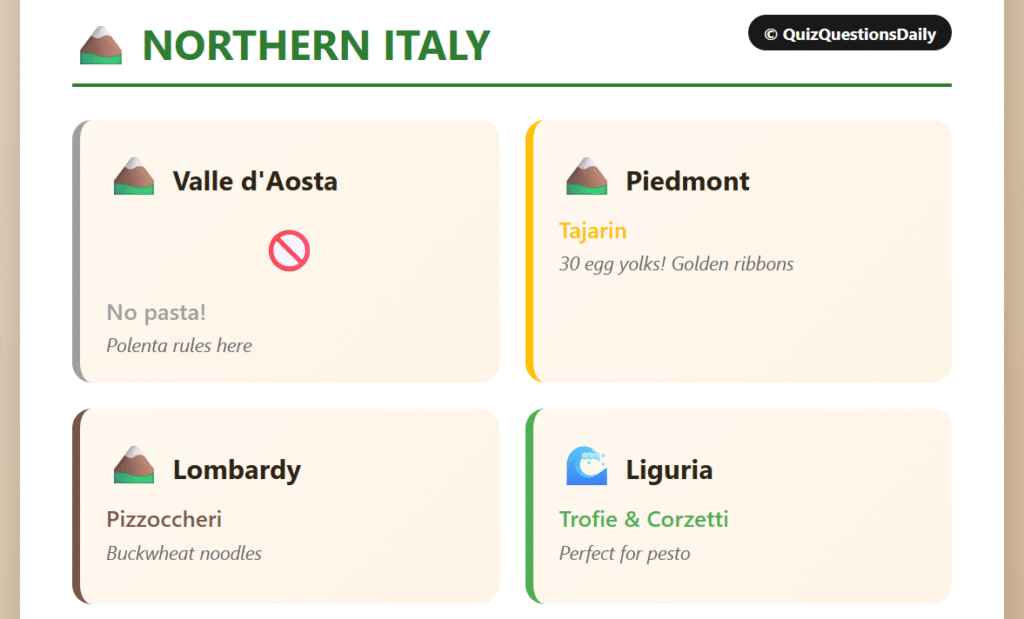
Question 14: Which region is famous for trofie pasta with pesto? Liguria (specifically Genoa)
💡Fun Fact: The traditional Ligurian pesto pasta includes boiled potatoes and green beans along with the trofie and pesto.
Question 15: What is malloreddus (Mah-loh-REH-doos) and where is it from? Small ridged pasta shells/dumplings from Sardinia
💡Fun Fact: Traditional malloreddus dough includes saffron, giving it a distinctive golden-orange color and making it one of Italy’s most expensive pastas.
Question 16: In Puglia, they make orecchiette by hand. What does the traditional cook use to shape them? Their thumb
💡Fun Fact: In Bari’s old town, elderly women sit in the streets hand-making orecchiette for tourists. Each one is dragged and shaped individually with their thumbs.
Question 17: What is the traditional pasta shape for pasta alla Norma (Sicily)? A) Spaghetti B) Rigatoni C) Penne D) Bucatini B) Rigatoni (C) Penne (is also acceptable)
💡Fun Fact: When writer Nino Martoglio first tasted this dish, he exclaimed it was as wonderful as Bellini’s opera “Norma” and that’s how the name stuck.
Question 18: In Emilia-Romagna, the traditional way to say ‘handmade pasta’ in dialect is pasta __________. Sfoglia
💡Fun Fact: Sfogline who are female pasta makers in Bologna can roll pasta so thin you can read a newspaper through it. Now that’s a skill that takes decades to master.
Question 19: Which pasta shape is traditional in Abruzzo and means “guitar strings”? Spaghetti alla chitarra
💡Fun Fact: Spaghetti alla chitarra is made by pressing dough through a wooden frame with wire strings that literally looks like a guitar. This creates square-shaped spaghetti.
Question 20: What is “pici” and which region is it from? Pici is thick, hand-rolled spaghetti from Tuscany (Siena area)
💡Fun Fact: If you want authentic handmade Pici, make sure that it’s irregular and has uneven thickness. Perfectly uniform pici means it came from a machine.
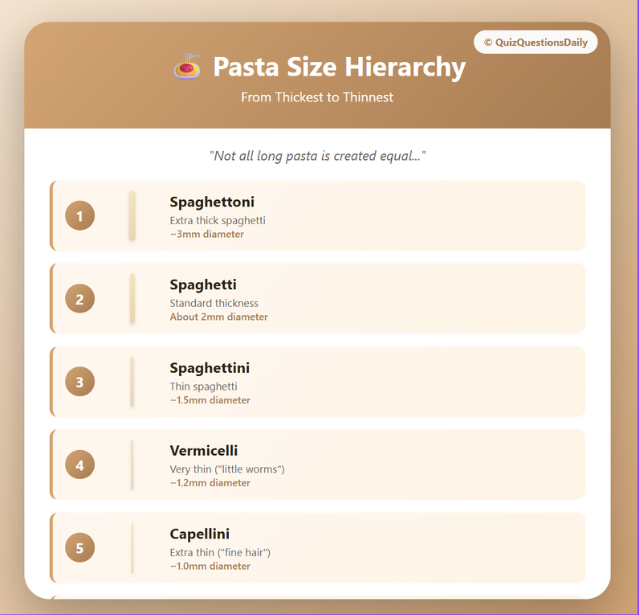
Question 21: In Naples, what do they call the very thin spaghetti that’s thinner than capellini? Capelli d’angelo (Angel hair)
💡Fun Fact: Capelli d’angelo is so thin (0.85mm) that it cooks in under 2 minutes. This makes it perfect for a quick meal, but so easy to overcook so be mindful of the time.
Question 22: Every region of Italy has at least one unique pasta shape found nowhere else. True
💡Fun Fact: Over 350 documented pasta shapes exist across Italy’s 20 regions. You could say that the Italy’s pasta diversity is only rivaled by its wine diversity.
Question 23: What is “fregula” and how is it different from couscous? Fregula is toasted Sardinian pasta pearls, larger and toasted unlike North African couscous.
💡Fun Fact: Can you guess the secret ingredient that makes fregula different from couscous? It’s the toasting which gives fregula a nutty flavor and golden color that couscous doesn’t have.
ROUND 3: The Chemistry & Science of Pasta (Question 24 – 30)
It’s time to understand the WHY behind cooking techniques. This is where most casual cooks fail.
Question 24: What percentage of pasta’s weight should come from the salted cooking water it absorbs?
Question 25: What chemical reaction occurs when you toast pasta before boiling it?
Question 26: Why does pasta water become starchy during cooking?
Question 27: What is the ideal salt concentration for pasta water?
Question 28: What happens to pasta at the molecular level when it reaches “al dente”?
Question 29: Why do Italians finish cooking pasta in the sauce?
Question 30: What happens to the boiling point of water when you add salt?
📊 Round 3 Complete! Check Your Answers:
Question 24: What percentage of pasta’s weight should come from the salted cooking water it absorbs? Around 20-25%
💡Fun Fact: This is why salting your water is so important. You’re seasoning the pasta from the inside out.
Question 25: What chemical reaction occurs when you toast pasta before boiling it?The Maillard reaction
💡Fun Fact: Maillard reaction is also the same reaction that you can thank for bread crusts and roasted coffee. It creates hundreds of new flavor compounds that makes our food more delicious.
Question 26: Why does pasta water become starchy during cooking? Starch molecules leach out during cooking
💡Fun Fact: Pasta water or as some call it, “liquid gold” acts as an emulsifier, helping create silky sauces without cream.
Question 27: What is the ideal salt concentration for pasta water? Around 1-2% salt by weight (or 1-2 tablespoon(s) per liter)
💡Fun Fact: Your pasta water should taste like ocean water. If it’s not salty enough, remember to pour in more salt.
Question 28: What happens to pasta at the molecular level when it reaches “al dente”? Starch granules gelatinize but the protein network remains firm, giving resistance when bitten.
💡Fun Fact: Al dente pasta also comes with lower glycemix index, making it a good choice for those with diabetes. It releases sugar more slowly than overcooked pasta.
Question 29: Why do Italians finish cooking pasta in the sauce? It allows the starch to help bind sauce and also makes it taste better.
💡Fun Fact: Cooking pasta in sauce helps create an emulsion where the sauce will cling to every strand. This is different than the more American “drain and dump” method where the sauce tends to slide off.
Question 30: What happens to the boiling point of water when you add salt? It makes practically no difference.
💡Fun Fact: We might have read in science class that salt increases boiling point. But for pasta, the increase is only negligible (only about 0.5°C/1°F). We add salt for flavor, not temperature.
Calculate Your Total Score for Culinary Kitchen: _/30
🔥 CONTROVERSIAL HOT TAKE #2
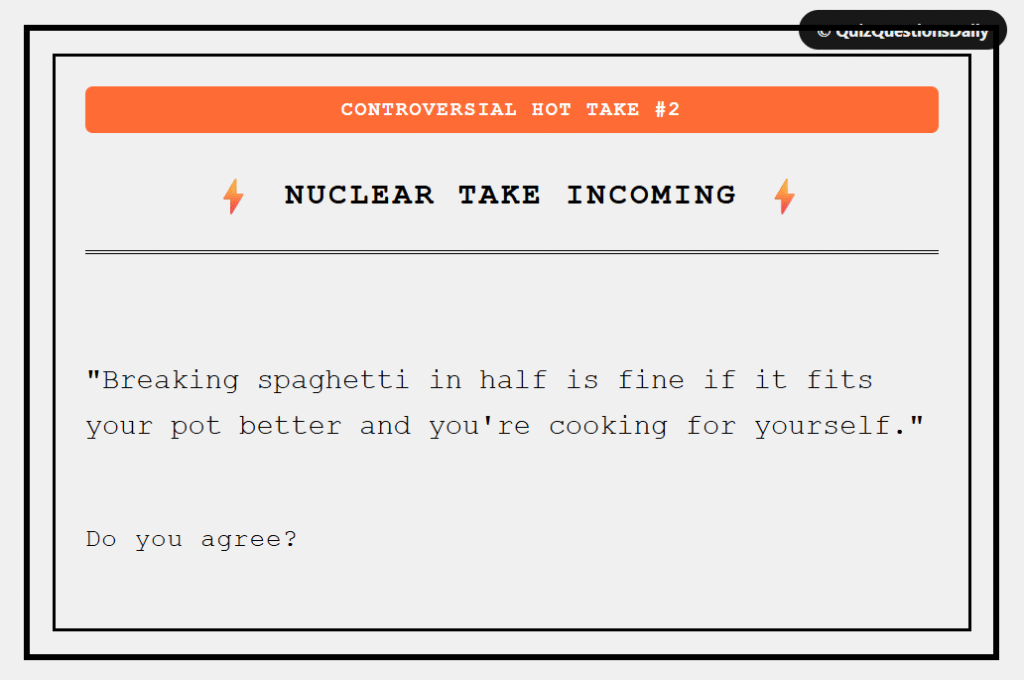
Community Vote Results:
- 87% say: “ITALIAN WAR CRIME”
- 13% say: “My kitchen, my rules”
🔥 HELL’S KITCHEN (Expert)
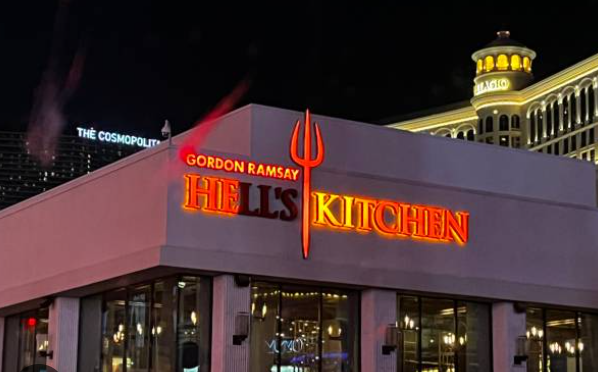
“Let’s hope you’re not an idiot sandwich.”
What You’re Getting:
- 50 questions, absolutely brutal
- Obscure regional dialects, chemistry, history
- Only for pasta maniacs
ROUND 1: Obscure Pasta Shapes & Regional Dialects (Questions 1-10)
Question 1: What is the difference between “sagne” and “lasagne”?
Question 2: In the Lazio dialect, what do locals call bucatini?
Question 3: What is “tria” in Salento (southern Puglia) and how is it prepared?
Question 4: “Corzetti” pasta from Liguria is traditionally stamped with __________.
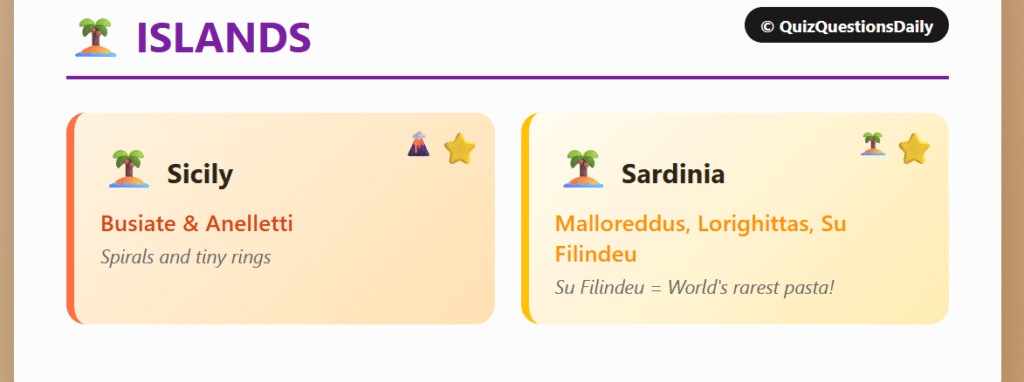
Question 5: What is “lorighittas” and which island is it from?
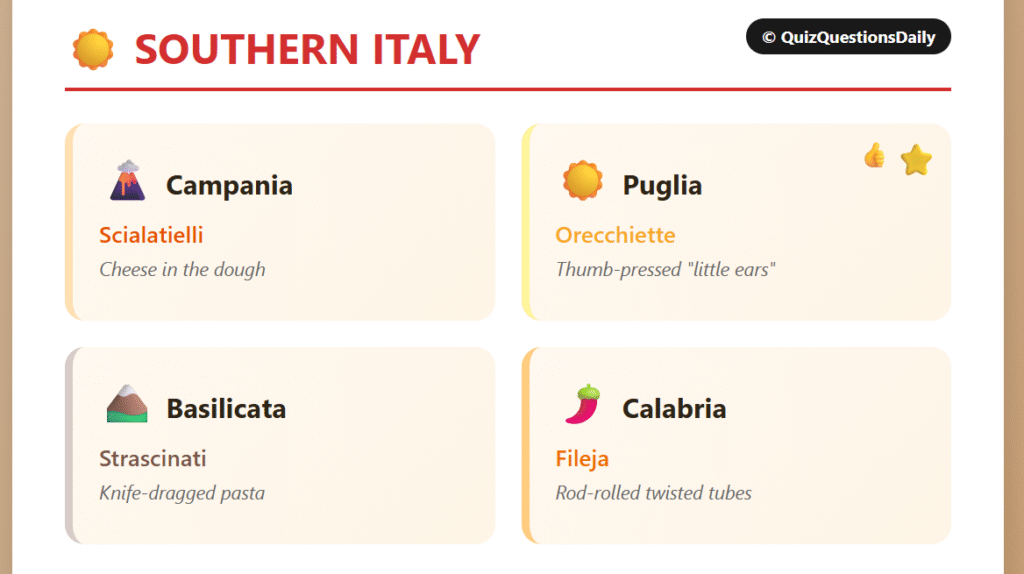
Question 6: In Basilicata, what is “strascinati” and what does the name mean?
Question 7: What is the primary difference between “maccheroni al ferretto” and regular maccheroni?
Question 8: What is “su filindeu” and why is it considered one of the world’s rarest pastas?
Question 9: In Campania, what is “scialatielli” made with that makes it unique?
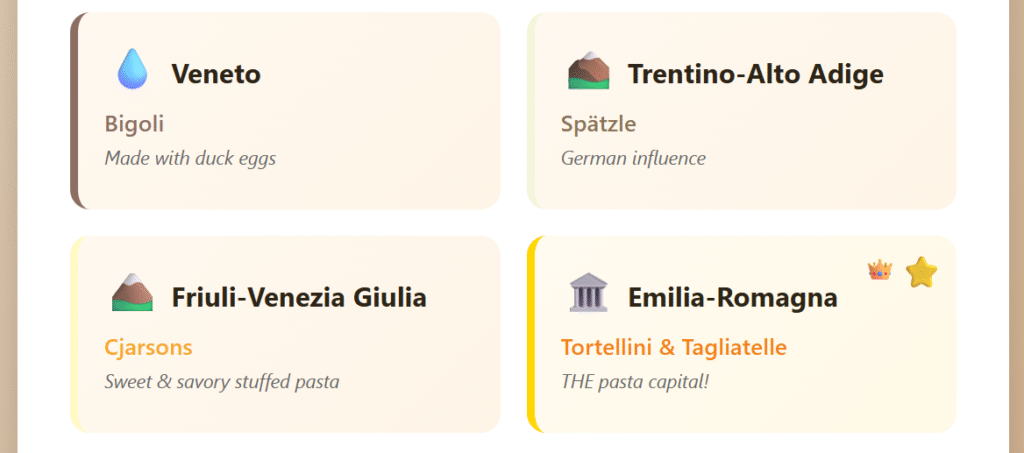
Question 10: What does “pizzoccheri” contain that most pasta doesn’t?
📊 Round 1 Complete! Check Your Answers:
Question 1: What is the difference between “sagne” and “lasagne”? Sagne are irregular, hand-torn lasagna sheets from Abruzzo/Molise, while lasagne are uniform rectangular sheets.
Question 2: In the Lazio dialect, what do locals call bucatini? Perciatelli
💡Fun Fact: “Perciato” means “pierced” in Roman dialect. Same pasta, different name depending on which neighborhood you’re in.
Question 3: What is “tria” in Salento (southern Puglia) and how is it prepared? Tria is pasta cut into irregular ribbons, half boiled and half fried, served with chickpeas (ciceri e tria)
💡Fun Fact: This Arab-influenced dish dates back centuries. The mix of crispy fried and tender boiled pasta in one dish sounds delicious to me.
Question 4: “Corzetti” pasta from Liguria is traditionally stamped with __________. Wooden stamps carved with family crests or decorative patterns
💡Fun Fact: Noble families had custom stamps made, so you could literally see whose pasta you were eating by the design. Maybe I should get one for this site.
Question 5: What is “lorighittas” and which island is it from? Braided ring-shaped pasta from Sardinia, specifically Morgongiori village
💡Fun Fact: Each ring is braided by hand around two fingers. This is a very labor-intensive that only very few people in the world still make it traditionally.
Question 6: In Basilicata, what is “strascinati” and what does the name mean? Hand-dragged pasta (the name itself means “dragged”) which is similar to orecchiette but more elongated due to dragging it with a knife .
💡Fun Fact: Each piece is dragged across a wooden board with a butter knife – the rustic texture is impossible to replicate by machine.
Question 7: What is the primary difference between “maccheroni al ferretto” and regular maccheroni? Maccheroni al ferretto is rolled around a thin rod (ferretto/knitting needle), which creates a hollow tube with a hole.
Fun Fact: Found in Calabria and Sicily, each region argues about the “correct” thickness – ferretti range from 2-8mm.
Question 8: What is “su filindeu” and why is it considered one of the world’s rarest pastas? The “Threads of God” or ultra-thin Sardinian pasta which is pulled by hand into 256 strands, and it’s made by only 3 women in the world.
💡Fun Fact: Even Jamie Oliver failed to learn this technique (looks like fried rice isn’t the only thing he couldn’t master). The knowledge is passed down through one family for generations.
Question 9: In Campania, what is “scialatielli” made with that makes it unique? Scialatielli is fresh pasta which made with milk (or water), flour, eggs, and grated cheese mixed into the dough itself.
💡Fun Fact: This pasta was invented in the 1960s by chef Enrico Cosentino in Amalfi. The cheese in the dough makes it exceptionally tender and excuse me while I go and look for a recipe.
Question 10: What does “pizzoccheri” contain that most pasta doesn’t? Buckwheat flour (80% buckwheat, 20% wheat flour)
💡Fun Fact: From Valtellina (Lombardy), it’s naturally gray-brown and traditionally served with cabbage, potatoes, and mountains of melted cheese.
ROUND 2: Pasta History & Etymology (Questions 11 – 20)
Question 11: What is the earliest written record of pasta in Italy?
Question 12: What was pasta called in ancient Rome?
Question 13: In what century did dried pasta become commercially available in Italy
Question 14: What does “vermicelli” literally translate to and why was it named that?
Question 15: Who is credited with inventing the modern pasta extruder/die?
Question 16: What was the “Manifesto of Futurist Cooking” position on pasta in 1930?
Question 17: What year did instant ramen (pasta’s Asian cousin) get invented?
Question 18: Where does the word “macaroni” come from etymologically?
Question 19: What is the “Accademia Italiana della Cucina” and what do they do regarding pasta?
Question 20: In the 1700s, what nickname were pasta-eating Neapolitans given?
ANSWER: “Mangiamaccheroni” (macaroni eaters) or “mangiafoglie” (leaf eaters) ✓
📊 Round 2 Complete! Check Your Answers:
Question 11: What is the earliest written record of pasta in Italy? 1154 which is when Arab geographer Al-Idrisi described “itriyya” (dried string pasta) being made in Sicily.
💡Fun Fact: This predates Marco Polo’s birth by 100+ years which definitively debunks the China myth.
Question 12: What was pasta called in ancient Rome? “Lagana” (plural: lagane) which are flat sheets of dough, precursor to lasagna.
💡Fun Fact: The Romans liked to eat it baked and not boiled. The more modern pasta cooking techniques were developed centuries later.
Question 13: In what century did dried pasta become commercially available in Italy? 13th-14th century (1200s-1300s)
💡Fun Fact: The fact that you could finally dry pasta is when trade was revolutionized. Pasta could finally now be stored and transported without spoiling.
Question 14: What does “vermicelli” literally translate to and why was it named that? “Little worms” – named for its thin, worm-like appearance
💡Fun Fact: In the 1400s, vermicelli was considered a luxury item eaten by the wealthy. How the times have changed!
Question 15: Who is credited with inventing the modern pasta extruder/die? Cesare Spadaccini in 1825 (or possibly earlier inventors in the 1700s. This fact is debated)
💡Fun Fact: Bronze dies (vs. modern Teflon) create a rougher texture that holds sauce better and that’s why premium pasta costs more.
Question 16: What was the “Manifesto of Futurist Cooking” position on pasta in 1930? Futurist artist Marinetti wanted to abolish pasta, calling it “an absurd Italian gastronomic religion”
💡Fun Fact: He claimed pasta made Italians sluggish – the backlash was so severe he had to recant. If there’s something that you need to take from this, it’s that you don’t mess with Italians or their pasta.
Question 17: What year did instant ramen (pasta’s Asian cousin) get invented? 1958 by Momofuku Ando in Japan
💡Fun Fact: Ando ate instant ramen every day for the last 25 years of his life and lived to 96. Time to show this fact to my sister who’s a dietian.
Question 18: Where does the word “macaroni” come from etymologically? Possibly from Greek “makaria” (food made from barley) or Italian “maccare” (to crush/bruise)
Question 19: What is the “Accademia Italiana della Cucina” and what do they do regarding pasta? Italian Academy of Cuisine documents and preserves traditional Italian recipes, including “official” pasta recipes.
Question 20: In the 1700s, what nickname were pasta-eating Neapolitans given? “Mangiamaccheroni” (macaroni eaters) or “mangiafoglie” (leaf eaters)
💡Fun Fact: Before tomatoes, Neapolitans ate pasta with just olive oil and cheese. Tomato sauce only became common in the 1800s.
ROUND 3: Advanced Techniques & Professional Methods (Questions 21-30)
Question 21: What is the professional pasta cooking ratio used in high-end Italian restaurants?
Question 22: What is “doppia cottura” and when is it used?
Question 23: What temperature should egg yolks reach maximum emulsification for carbonara?
Question 24: What is the “risottare” technique in pasta cooking?
Question 25: What is the purpose of “mantecatura a freddo”?
Question 26: What is the ideal hydration percentage for fresh egg pasta dough?
Question 27: What is “laminazione” in pasta making?
Question 28: What does “rapprendere” mean in pasta sauce technique?
Question 29: What is the purpose of “spolverare di farina” during fresh pasta making?
Question 30: What is “cavallatura” in traditional pasta making?
📊 Round 3 Complete! Check Your Answers:
Question 21: What is the professional pasta cooking ratio used in high-end Italian restaurants? 10-1-100 rule: 10 liters water, 100g pasta, 100g salt per 1kg pasta
💡Fun Fact: Restaurants use less water than home cooks to create more concentrated starchy water for better sauce emulsions.
Question 22: What is “doppia cottura” and when is it used? Double cooking which is basically parcooking pasta, then finishing later. This is used in restaurants for service efficiency.
💡Fun Fact: High-end restaurants parcook to 70%, chill immediately, then finish à la minute when ordered which maintains perfect texture.
Question 23: What temperature should egg yolks reach maximum emulsification for carbonara? 60-65°C (140-149°F). It needs to be below 70°C to avoid scrambling
💡Fun Fact: Professional chefs use thermometers for carbonara. People like me rely on feel and prayers.
Question 24: What is the “risottare” technique in pasta cooking? This is when you cooking pasta like risotto. You toast them dry, then add liquid gradually while stirring constantly.
💡Fun Fact: This technique creates ultra-creamy texture without cream which is why it’s used for high-end cacio e pepe and other cheese-based sauces.
Question 25: What is the purpose of “mantecatura a freddo”? Cold creaming, which is adding cheese/butter off heat while tossing vigorously to create smooth emulsion.
💡Fun Fact: Cold creaming is the secret to restaurant-quality glossy sauces. The heat causes cheese to separate and become grainy.
Question 26: What is the ideal hydration percentage for fresh egg pasta dough? 50-55% (50-55g liquid per 100g flour)
Question 27: What is “laminazione” in pasta making? The process of rolling dough through progressively thinner settings to help develop gluten structure.
💡Fun Fact: If making pasta, we should pass it through each setting 2-3 times, folding between passes. Remember that rushing through it creates weak pasta that tears.
Question 28: What does “rapprendere” mean in pasta sauce technique? It means to thicken/reduce sauce to proper consistency before adding pasta.
💡Fun Fact: The sauce should coat the back of a spoon before we add our pasta because watery sauce = watery dish.
Question 29: What is the purpose of “spolverare di farina” during fresh pasta making? Dusting with flour to prevent sticking during cutting and drying.
💡Fun Fact: Using semolina flour for dusting, not regular flour, is better because it doesn’t absorb into the pasta and keeps the pieces separate.
Question 30: What is “cavallatura” in traditional pasta making? The technique of draping fresh pasta sheets over a rod/stick to dry evenly The “horse” (cavallo) is the drying rack if you’re confused. The sheets must dry slowly to prevent cracking.
ROUND 4: Extreme Regional Knowledge (Question 31-40)
Question 31: What is “menuzze” in Molise dialect and how does it differ from similar pastas?
Question 32: In Valle d’Aosta (Italy’s smallest region), what is the traditional pasta pairing?
Question 33: What is “tajarin” in Piedmont and what makes it special?
Question 34: What is “bigoli” traditionally made with in Veneto?
Question 35: In Marche region, what makes “maccheroncini di Campofilone” unique?
Question 36: What is “manfricoli” or “manfrigoli” in Umbrian cuisine?
Question 37: What is “busiate” and which Sicilian town claims it?
Question 38: In Calabria, what is “fileja” (or “fileja”) shaped around?
Question 39: What is unique about “anelletti siciliani”?
Question 40: What is “culurgiones” and what distinguishes the Ogliastra method?
📊 Round 4 Complete! Check Your Answers:
Question 31: What is “menuzze” in Molise dialect and how does it differ from similar pastas? Tiny ferretto pasta which is smaller than standard maccheroni al ferretto and rolled around very thin rods
💡Fun Fact: Molise is Italy’s second-smallest region and often forgotten but their pasta game is strong.
Question 32: In Valle d’Aosta (Italy’s smallest region), what is the traditional pasta pairing? Trick question! The region specializes in polenta, rice, and potatoes
💡Fun Fact: This region is the exception to the “every region has pasta” rule because the French/Swiss influence dominates here.
Question 33: What is “tajarin” in Piedmont and what makes it special? It’s ultra-thin egg tagliatelle (1-2mm wide) and is made with up to 30 egg yolks per kilo of flour.
💡Fun Fact: The eggy (is this even a word?) richness makes it golden yellow and incredibly tender. It’s the go-to pasta for special occasions.
Question 34: What is “bigoli” traditionally made with in Veneto? Whole wheat flour and duck eggs which is then extruded through a bronze press (torchio)
💡Fun Fact: Bigoli is thick, rough, and humble and is perfect with anchovy sauce or duck ragù
Question 35: In Marche region, what makes “maccheroncini di Campofilone” unique? Ultra-thin egg pasta (thinner than capellini) with high egg content, IGP protected
💡Fun Fact: It’s made with 10 eggs per kilo and is so delicate it cooks in 1-2 minutes.
Question 36: What is “manfricoli” or “manfrigoli” in Umbrian cuisine? It’s basically hand-rolled irregular pasta cylinders. You could say that it’s similar to pici but shorter and chunkier.
💡Fun Fact: The name comes from “manfricare” (to rub), referring to the hand-rolling motion.
Question 37: What is “busiate” and which Sicilian town claims it? It is spiral pasta from Trapani (western Sicily), traditionally rolled around a “buso”.
Question 38: In Calabria, what is “fileja” (or “fileja”) shaped around? A thin rod, knitting needle, or ferretto which creates the twisted, hollow shape
💡Fun Fact: Each village has slightly different techniques and styles, and you can tell where someone’s nonna is from by their fileja.
Question 39: What is unique about “anelletti siciliani”? Small ring-shaped pasta traditionally used in “anelletti al forno” (Sicilian baked pasta)
💡Fun Fact: The rings trap sauce and cheese inside which essential for timballo and other baked dishes.
Question 40: What is “culurgiones” and what distinguishes the Ogliastra method Sardinian stuffed pasta and the Ogliastra method creates a distinctive wheat-stalk (spiga) pleated seal
💡Fun Fact: The pleating technique is so specific that in 2015, UNESCO recognized it as intangible cultural heritage.
ROUND 5: Pasta Science & Chemistry Deep Dive (41-50)
Question 41: What is the difference between amylose and amylopectin in pasta starch?
Question 42: What is the “glass transition temperature” in pasta and why does it matter?
Question 43: What protein percentage should durum wheat have for optimal pasta?
Question 44: What is retrogradation in cooked pasta?
Question 45: What is the water activity (aw) of properly dried pasta?
Question 46: What happens during the “gelatinization” phase of pasta cooking?
Question 47: What is the Maillard reaction temperature threshold and why is it relevant to pasta?
Question 48: What is the role of disulfide bonds in pasta structure?
Question 49: Why does altitude affect pasta cooking time?
Question 50: What is the “pasta paradox” in glycemic index?
📊 Round 5 (Final Round) Complete! Check Your Answers:
Question 41: What is the difference between amylose and amylopectin in pasta starch? Amylose is linear starch( which creates firmness) while amylopectin is branched (and that creates stickiness).
💡Fun Fact: Durum wheat has higher amylose content than regular wheat and that’s why pasta holds shape better than bread dough.
Question 42: What is the “glass transition temperature” in pasta and why does it matter? 40-70°C which is the temperature where pasta structure transitions from rigid to pliable during cooking
💡Fun Fact: Below this temp, pasta is crunchy while above it becomes edible. Understanding this explains why the texture of cold pasta feels different.
Question 43: What protein percentage should durum wheat have for optimal pasta? 12-15% protein content (higher protein = better structure and bite)
💡Fun Fact: Premium pasta uses 13%+ protein durum while cheap pasta uses lower protein wheat which is why it falls apart.
Question 44: What is retrogradation in cooked pasta? This is when the starches in cooled pasta recrystallize, making it firmer and resistant
💡Fun Fact: While retrogradation is why leftover pasta is chewier, it also has a a lower glycemic index than fresh. Retrograded starch is harder to digest.
Question 45: What is the water activity (aw) of properly dried pasta? Below 0.60 (typically 0.40-0.50)
💡Fun Fact: This low water activity is why dried pasta lasts years. Bacteria and mold can’t grow below 0.60 water activity.
Question 46: What happens during the “gelatinization” phase of pasta cooking?Starch granules absorb water, swell, and burst, releasing amylose molecules into surrounding water
💡Fun Fact: This is why pasta water gets cloudy and starchy, you’re literally watching starch molecules escape.
Question 47: What is the Maillard reaction temperature threshold and why is it relevant to pasta? It begins at 140°C (284°F) and is super relevant for toasted/baked pasta and brown crust on pasta al forno
💡Fun Fact: Boiling water is only 100°C, so Maillard doesn’t occur during cooking, only during baking/toasting.
Question 48: What is the role of disulfide bonds in pasta structure? Cross-link gluten proteins, providing strength and elasticity to pasta dough
💡Fun Fact: Kneading and resting allows these bonds to form properly. So remember, rushing = weak, tearable pasta.
Question 49: Why does altitude affect pasta cooking time? Water boils at lower temperatures at high altitude (e.g., 92°C at 2500m) which means requiring longer cooking
💡Fun Fact: In Denver (1600m elevation), water boils at 95°C and that adds 10-20% more to cooking time.
Question 50: What is the “pasta paradox” in glycemic index? Despite being refined carbs, pasta has moderate GI (45-55) due to tight protein-starch matrix slowing digestion.
Calculate Your Total Score for Culinary Kitchen: _/50
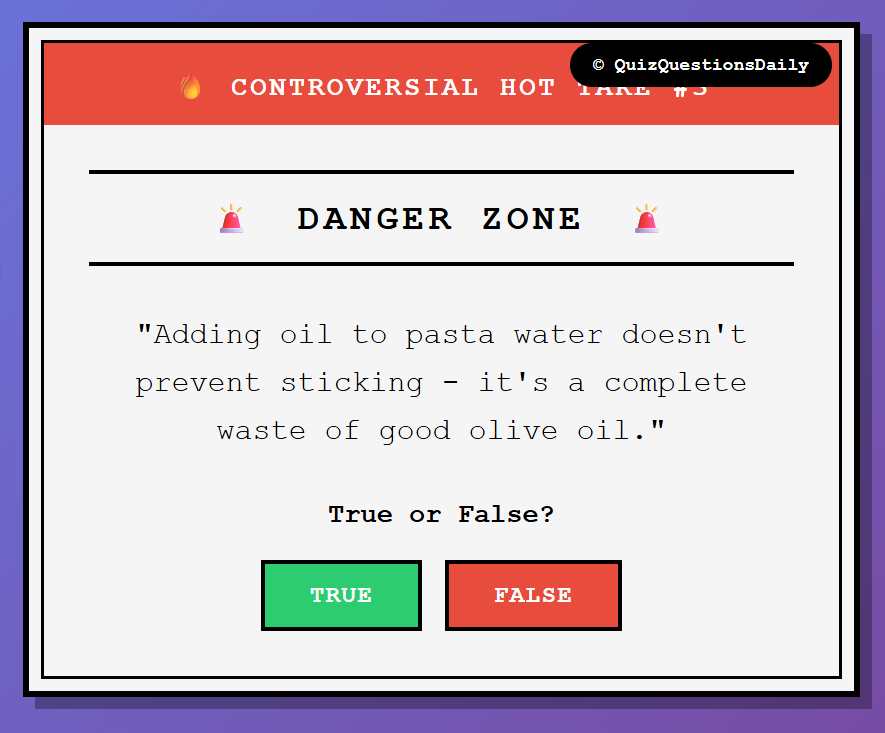
🔥 CONTROVERSIAL HOT TAKE #3
🏆 CONGRATULATIONS, YOU’VE COMPLETED THE ULTIMATE PASTA QUIZ QUESTIONS
Whether you conquered Nonna’s Kitchen, graduated from Culinary School, or survived Hell’s Kitchen… you’ve proven something important. You don’t just eat pasta. You understand it.
Let’s find your official pasta rank, shall we?
90-100%: 👑 PASTA GOD Nonna is jealous because you’ve transcended the realm of mere pasta knowledge. You could probably open a restaurant tomorrow and it’d be a hit.
70-89%: 🏆 PASTA MASTER You’ve more than earned your place at any Italian dinner table. Nonna wants you to marry into the family
50-69%: ⭐ PASTA EXPERT Extremely impressive! You know more than 95% of pasta eaters. Nonna thinks that it’s time to start making your own dough from scratch.
40-59%: 👨🍳 CERTIFIED PASTA PRO Solid foundation. You can hold your own in any pasta conversation and cook with confidence.
40-49%: 🌱 PASTA STUDENT You’ve got the basics down. Time to experiment in the kitchen and dive deeper into regional specialties.
30-49%: 🍝 PASTA ENTHUSIAST You know your stuff! More knowledge than most, with room to grow. Keep cooking, keep learning.
Below 30%: 🔰 PASTA NEWBIE Everyone starts somewhere, so don’t worry! Now you know what you didn’t know. Bookmark this page and come back after cooking some pasta.
Don’t forget to check out our other quizzes because trust me, if there’s anything that Nonna likes apart from pasta and wine, it’s quizzing. We’ve probably got one on wines too. Or barbeque. Or pretty much anything.
📄 [Printable Quiz Version] – Take it offline