100 Latest Science Quiz Questions with Answers [Ultimate Free PDF]
I recently came across a fun fact. Apparently, students with regularly engage with science quiz questions retain information 70% more than those those who only read their textbooks? Yup, you heard it. SEVENTY PERCENT.
I’ve spent years trying to remember facts for my quizzes at school, and this fact does make sense. Actively recalling information through fun quizzes destroys passive learning any time of the day. And to be honest, that’s also why you’re here looking for science quiz questions and answers.
Whether you’re searching for science quiz questions for kids or need current affairs science quiz questions for competitive exams, I’ve got you covered.
I’ve gone through all the resources and managed to create 100 science quiz questions with answers that cover everything from basic biology to the latest breakthroughs in 2025. And yes, before you ask, there’s a free PDF download waiting for you at the end (because who doesn’t love a good resource they can actually use, right?).
Let’s put on our quizzing hats, shall we?
🧒 Round 1: Easy Science Quiz Questions for Kids
These science quiz questions are perfect for ages 6-12. They’ll spark curiosity and make science fun.
1. What is the largest planet in our solar system?
2. What do plants need to make their own food?
3. How many bones does an adult human have?
4. What is the hardest natural substance on Earth?
5. What gas do plants give off that humans need to breathe?
6. What is the fastest land animal?
7. What is the center of an atom called?
8. How many legs does a spider have?
9. What is the chemical symbol for water?
10. Which planet is known as the “Red Planet”?
11. What is the largest organ in the human body?
12. What do you call a baby frog?
13. How many teeth does an adult human have?
14. What is the process called when a caterpillar becomes a butterfly?
15. What is the closest star to Earth?
16. What do bees collect from flowers?
17. What are the three states of matter?
18. Which animal is known for changing colors?
19. What is the boiling point of water?
20. How long does it take for Earth to orbit the Sun?
📊 Round 1 Easy Science Quiz Questions for Kids Complete! Check Your Answers:

Science Quiz Questions for kids: Solar System
1. What is the largest planet in our solar system? Jupiter
💡 Fun Fact: Jupiter is so big that 1,300 Earths could fit inside it.
2. What do plants need to make their own food? Sunlight, water, and carbon dioxide (through photosynthesis which you can think of as a plant’s way of eating sunshine)
3. How many bones does an adult human have? 206 bones
💡 Fun Fact: Babies are born with around 300 bones, but many fuse together as they grow up.
4. What is the hardest natural substance on Earth? Diamond
💎 Fun Fact: Despite being the hardest natural material, diamonds can actually burn if exposed to a high enough temperature (around 763°C). They’re made of carbon, just like coal and graphite in your pencil.
5. What gas do plants give off that humans need to breathe? Oxygen
🌳 Fun Fact: One large tree can provide enough oxygen for two people for an entire year! The Amazon rainforest produces about 20% of the world’s oxygen.
6. What is the fastest land animal? Cheetah (can run up to 70 mph or 112 km/h)
🐆 Fun Fact: Cheetahs can go from 0 to 60 mph in just 3 seconds which is faster than most sports cars. But they can only maintain this speed for about 20-30 seconds before overheating.
7. What is the center of an atom called? Nucleus
⚛️ Fun Fact: If an atom were the size of a football stadium, the nucleus would be about the size of a pea in the center. Atoms are mostly empty space.
8. How many legs does a spider have? 8 legs
🕷️ Fun Fact: Spiders aren’t insects; they’re arachnids! Insects have 6 legs, while arachnids have 8. Also, spider silk is stronger than steel of the same thickness.
9. What is the chemical symbol for water? H₂O
💧 Fun Fact: Your body is about 60% water! Also, there’s the same amount of water on Earth now as there was 3 billion years ago which means you could be drinking water that dinosaurs once drank.
10. Which planet is known as the “Red Planet”? Mars
🔴 Fun Fact: Mars appears red because its surface is covered in iron oxide (rust). A day on Mars is almost the same as Earth, around 24 hours and 37 minutes.
11. What is the largest organ in the human body? Skin
👤 Fun Fact: Your skin completely replaces itself every 28 days. You’ll shed about 40 pounds of skin in your lifetime. Humans also shed about 30,000-40,000 dead skin cells every minute.
12. What do you call a baby frog? Tadpole
🐸 Fun Fact: Tadpoles are completely vegetarian, but adult frogs are carnivores. As they transform, they actually absorb their tail back into their body for nutrition.
13. How many teeth does an adult human have? 32 teeth
🦷 Fun Fact: Tooth enamel is the hardest substance in the human body, even harder than bone. But unlike bones, teeth can’t heal themselves once damaged.
14. What is the process called when a caterpillar becomes a butterfly? Metamorphosis
🦋 Fun Fact: Inside the cocoon, the caterpillar completely liquefies into a protein soup before reforming as a butterfly. Some butterflies can remember things they learned as caterpillars.
15. What is the closest star to Earth? The Sun
☀️ Fun Fact: The Sun is so big that about 1.3 million Earths could fit inside it. Light from the Sun takes 8 minutes and 20 seconds to reach Earth.
16. What do bees collect from flowers? Nectar (which they turn into honey)
🐝 Fun Fact: A single bee produces only about 1/12th of a teaspoon of honey in its entire lifetime. It would take about 12 bees their whole lives to make one teaspoon of honey.
17. What are the three states of matter? Solid, liquid, and gas
🔄 Fun Fact: There’s actually a fourth state of matter called plasma. You can find it in lightning, neon signs, and makes up 99% of the visible universe (like stars).
18. Which animal is known for changing colors? Chameleon
🎨 Fun Fact: Chameleons don’t change color to match their surroundings, but rather, they do it to communicate emotions, regulate temperature, and attract mates. Their color changes are controlled by special cells called chromatophores.
19. What is the boiling point of water? 100°C (212°F)
🌡️ Fun Fact: Water’s boiling point changes with altitude. On top of Mount Everest, water boils at just 68°C (154°F) because there’s less air pressure. That’s why cooking takes longer at high altitudes.
20. How long does it take for Earth to orbit the Sun? 365 days (one year)
🌍 Fun Fact: Earth is traveling through space at about 67,000 mph (107,000 km/h). We don’t feel it because we’re moving with it, like being in a smooth airplane.
🧬 Round 2: General Biology Science Quiz Questions and Answers
The next few rounds (2 to 5) will cover the core scientific concepts everyone should know. This is perfect if you wanna go through everything quickly.
21. What is the powerhouse of the cell?
22. What is DNA?
23. What is the largest organ inside the human body?
24. How many chambers does the human heart have?
25. What is the process by which plants make food?
26. What is the basic unit of life?
27. What is the study of living organisms called?
28. How many chromosomes do humans have?
29. What is the largest type of blood vessel?
30. What is the scientific name for humans?
📊 Round 2 General Biology Science Quiz Questions and Answers Complete! Check Your Answers:
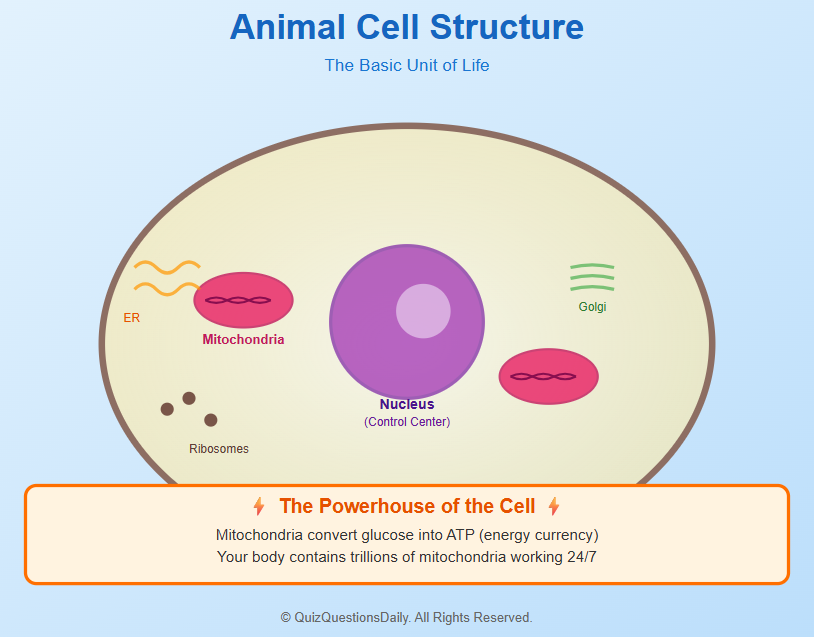
Science Quiz Questions with answers: Mitochondria
21. What is the powerhouse of the cell? Mitochondria
🔬 Go Deeper: Mitochondria convert glucose into ATP (adenosine triphosphate), the energy currency of cells.
22. What is DNA? Deoxyribonucleic acid, which is the molecule that carries genetic information
💡 Fun Fact: If you unraveled all the DNA in your body, it would stretch from Earth to the Sun and back 600 times.
23. What is the largest organ inside the human body? Liver
🫀 Fun Fact: Your liver can regenerate itself. If you remove up to 75% of the liver, it can grow back to its full size within a few months. It’s the only organ with this amazing ability.
24. How many chambers does the human heart have? Four (two atria and two ventricles)
❤️ Fun Fact: Your heart beats about 100,000 times per day, pumping roughly 2,000 gallons of blood. Over your lifetime, that’s about 3 billion heartbeats. The “thump-thump” sound is your heart valves closing.
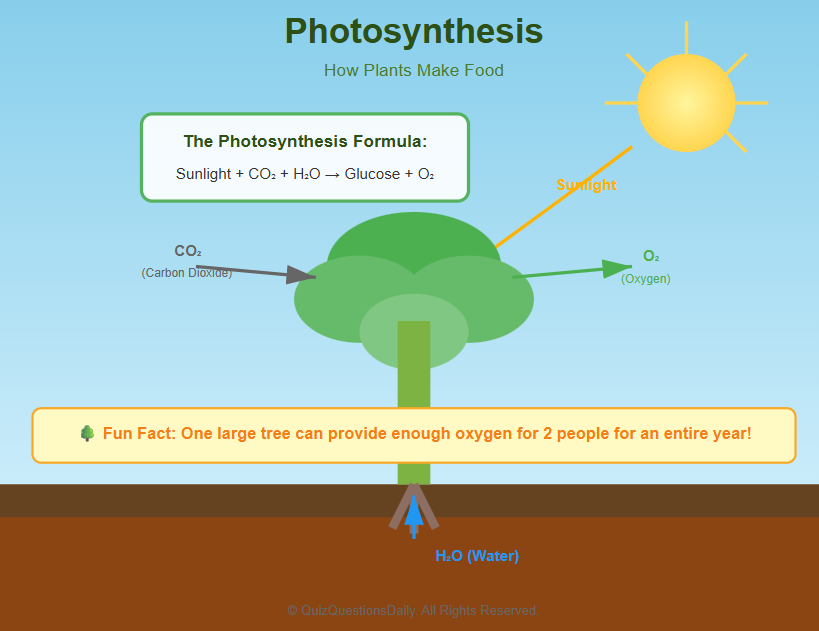
Science Quiz Questions with Answers: Photosynthesis
25. What is the process by which plants make food? Photosynthesis
🌱 Fun Fact: Photosynthesis is the reason we can breathe. It produces virtually all the oxygen in Earth’s atmosphere. Without plants and photosynthetic bacteria, Earth would be as lifeless as Mars.
26. What is the basic unit of life? Cell
🔬 Fun Fact: Your body contains about 37.2 trillion cells. If you lined them all up, they’d circle the Earth over 200 times. You’re losing and replacing about 50-70 billion cells every single day. Isn’t our body amazing?
27. What is the study of living organisms called? Biology
📚 Fun Fact: The word “biology” comes from Greek: “bios” (life) and “logos” (study). There are over 8.7 million species on Earth, and we’ve only discovered and named about 1.2 million of them.
28. How many chromosomes do humans have? 46 (23 pairs)
🧬 Fun Fact: You inherit 23 chromosomes from each parent. Interestingly, bananas have 22 chromosomes, and a single potato has 48 which is more than humans. Always remember that chromosome number doesn’t determine complexity.
29. What is the largest type of blood vessel? Artery (specifically, the aorta)
🫁 Fun Fact: If you laid out all the blood vessels in your body end to end, they’d stretch about 60,000 miles. That’s enough to circle the Earth more than twice.
30. What is the scientific name for humans? Homo sapiens
🧠 Fun Fact: “Homo sapiens” is Latin for “wise man.” Modern humans have only existed for about 300,000 years which is a tiny fraction of Earth’s 4.5 billion year history. We share 98.8% of our DNA with chimpanzees.
🧪 Round 3: General Chemistry Science Quiz Questions and Answers
31. What is the chemical symbol for gold?
32. What is the pH of pure water?
33. What are the three subatomic particles?
34. What is the most abundant element in the universe?
35. What is the process of a solid turning directly into a gas called?
36. How many elements are in the periodic table?
37. What is the chemical formula for table salt?
38. What is the lightest element?
39. What is an atom with a different number of neutrons called?
40. What gas makes up about 78% of Earth’s atmosphere
📊 Round 3 General Chemistry Science Quiz Questions and Answers Complete! Check Your Answers:
31. What is the chemical symbol for gold? Au (from the Latin “aurum”)
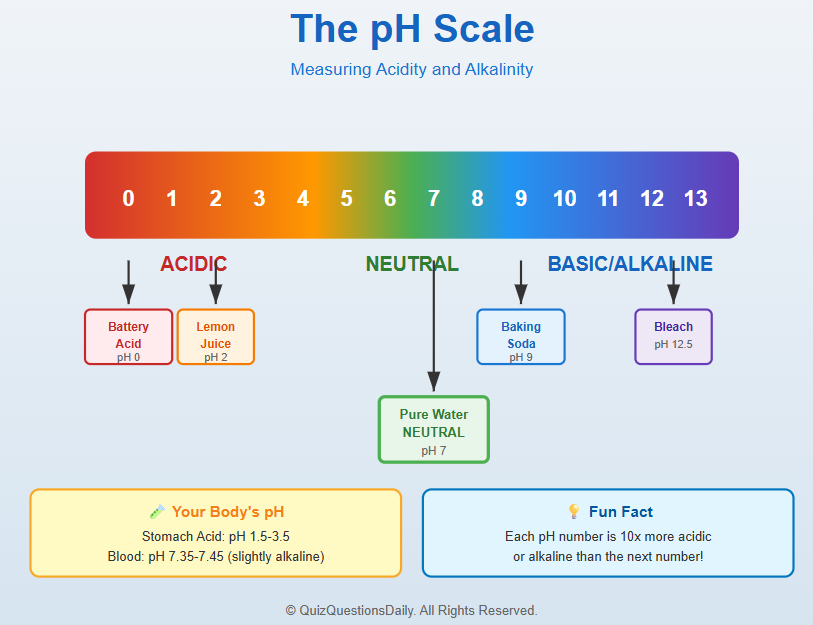
Science Quiz Questions with Answers: pH Scale
32. What is the pH of pure water? 7 (neutral)
📊 Fun Fact: The pH scale goes from 0 (most acidic) to 14 (most basic). Your stomach acid has a pH of about 1.5-3.5, while household bleach is around 12.5. Pure water is perfectly neutral at 7.
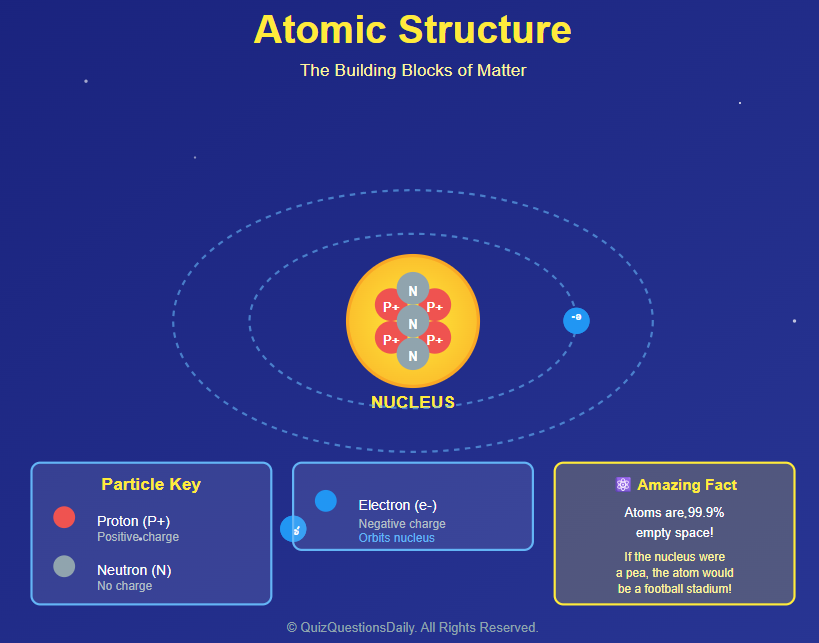
33. What are the three subatomic particles? Protons, neutrons, and electrons
Science Quiz Questions with Answers: Atom
⚡ Fun Fact: Electrons are so tiny that they’re about 1,836 times lighter than protons. Also, electrons move around the nucleus at speeds close to the speed of light which is about 1,400 miles per second.
34. What is the most abundant element in the universe? Hydrogen
🌌 Fun Fact: Hydrogen makes up about 75% of all matter in the universe! It’s also the simplest element because it has just one proton and one electron. Every element heavier than hydrogen was created inside stars.
35. What is the process of a solid turning directly into a gas called? Sublimation
❄️ Fun Fact: Dry ice (frozen carbon dioxide) sublimates at room temperature, which is why it creates that cool fog effect. Snow can also sublimate in very cold, dry conditions. You can see that it just disappears without melting.
36. How many elements are in the periodic table? 118 confirmed elements (as of 2025)
🧪 Fun Fact: Only 94 elements occur naturally on Earth. The rest are synthetic and created in laboratories. The newest elements are so unstable they exist for only fractions of a second.
37. What is the chemical formula for table salt? NaCl (sodium chloride)
🧂 Fun Fact: Pure sodium explodes when it touches water, and pure chlorine is a toxic gas used in WWI as a weapon. But when combined, they make the safe, tasty salt we put on our food.
38. What is the lightest element? Hydrogen
🎈 Fun Fact: Hydrogen is 14 times lighter than air. Early airships (blimps) used hydrogen, but it’s highly flammable. The famous Hindenburg disaster in 1937 led to helium replacing hydrogen in modern airships.
39. What is an atom with a different number of neutrons called? Isotope
☢️ Fun Fact: Some isotopes are radioactive and used in medicine! For example, radioactive iodine helps treat thyroid cancer, and carbon-14 isotopes let scientists date ancient fossils and artifacts.
40. What gas makes up about 78% of Earth’s atmosphere? Nitrogen
🌬️ Fun Fact: Despite being everywhere around us, nitrogen gas (N₂) is very unreactive. Your body can’t use atmospheric nitrogen directly. Bacteria in soil and plant roots must “fix” it first before plants and animals can use it.
Just like how the molecular structure of pasta proteins affects texture and cooking properties (learn more about the fascinating science of pasta), understanding chemistry helps us appreciate everyday phenomena around us.
🌀 Round 4: General Physics Science Quiz Questions and Answers
41. What is the speed of light?
42. Who developed the theory of relativity?
43. What is the unit of force?
44. What is the law that states “every action has an equal and opposite reaction”?
45. What is the unit of electrical resistance?
46. What type of energy is stored in a stretched spring?
47. What is the acceleration due to gravity on Earth?
48. What is the smallest unit of light?
49. What is absolute zero?
50. What is the phenomenon where light bends when passing through different mediums?
📊 Round 4 General Physics Science Quiz Questions and Answers Complete! Check Your Answers:

Science Quiz Questions with Answers: Speed of light
41. What is the speed of light? 300,000 km/s
42. Who developed the theory of relativity? Albert Einstein
🧠 Fun Fact: Einstein’s brain was preserved after his death and studied by scientists. It had an unusually large inferior parietal lobe, which may have contributed to his mathematical abilities. Also, he failed his university entrance exam on the first try.
43. What is the unit of force? Newton (N)
🍎 Fun Fact: The unit is named after Isaac Newton, inspired by the (probably fictional) story of an apple falling on his head. Interestingly, one Newton is roughly the force of a small apple resting in your hand.
44. What is the law that states “every action has an equal and opposite reaction”? Newton’s Third Law of Motion
🚀 Fun Fact: This is exactly how rockets work in space. They push exhaust gases backward, and the equal-opposite reaction pushes the rocket forward. It even works in the vacuum of space where there’s nothing to “push against”.
45. What is the unit of electrical resistance? Ohm (Ω)
⚡ Fun Fact: The Ohm symbol (Ω) is the Greek letter Omega. Georg Ohm, who discovered Ohm’s Law, faced harsh criticism initially and his work was rejected but he was eventually vindicated and honored.
46. What type of energy is stored in a stretched spring? Elastic potential energy
🌀 Fun Fact: This same principle powers pogo sticks, trampolines, and even the valves in your heart. The energy storage capacity of springs made mechanical watches possible before batteries were invented.
47. What is the acceleration due to gravity on Earth? Approximately 9.8 m/s²
🪐 Fun Fact: Gravity varies slightly across Earth. You’d weigh about 0.5% more at the poles than at the equator due to Earth’s rotation and slightly flattened shape. The Moon’s gravity is only 1/6th of Earth’s.
48. What is the smallest unit of light? Photon
💡 Fun Fact: Photons have no mass, yet they carry momentum. This amazing fact enables “solar sails” which are spacecraft that use pressure from sunlight to propel themselves through space without fuel.
49. What is absolute zero? -273.15°C (-459.67°F or 0 Kelvin). It is the theoretical temperature at which particles have minimum thermal motion
🥶 Fun Fact: Scientists have gotten only within a billionth of a degree of absolute zero in labs, but can never reach it exactly because it would violate the laws of quantum mechanics. At near absolute zero, weird things happen: helium becomes a “superfluid” that can flow uphill.
Science Quiz Questions with Answers: Refraction
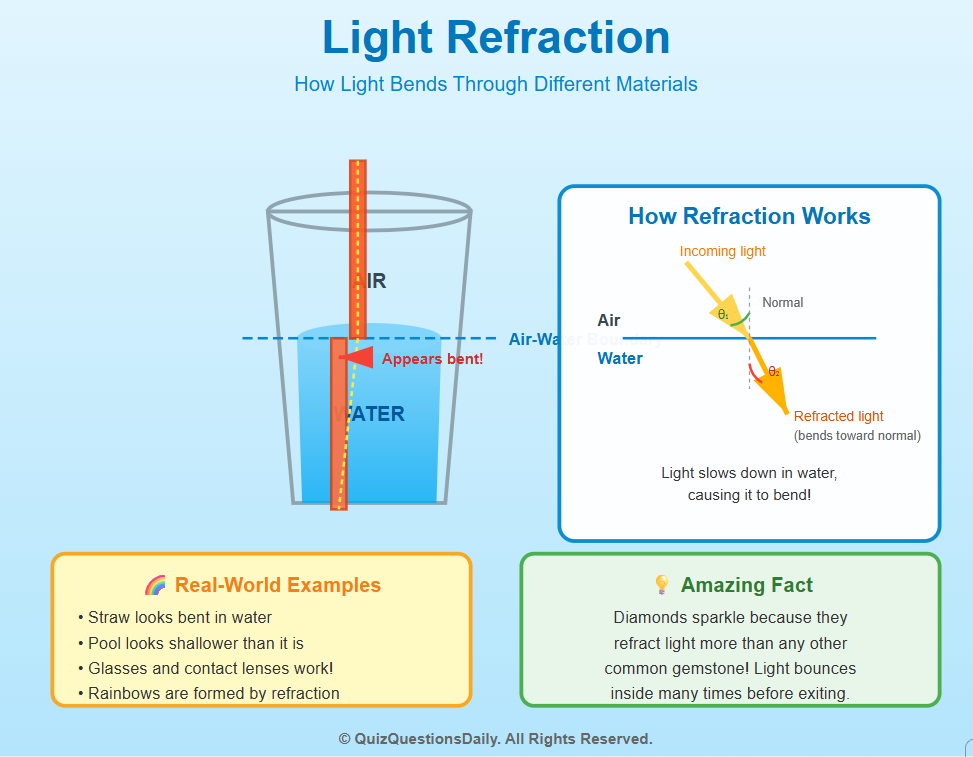
50. What is the phenomenon where light bends when passing through different mediums? Refraction
🌈 Fun Fact: Refraction is why a straw in a glass of water appears bent. It’s also what creates mirages in deserts because when light bends through layers of hot and cool air, making distant objects appear reflected as if in water.
The engineering principles behind London’s iconic Tower Bridge demonstrate physics in action all the way from tension and compression to the mechanics of the bascule system. Speaking of London, exploring its famous science museums can deepen your understanding of these concepts.
🌍 Round 5: General Earth Science Quiz Questions and Answers
51. What are the three types of rocks?
52. What is the outermost layer of Earth called?
53. What causes earthquakes?
54. What is the study of weather called?
55. What percentage of Earth’s surface is covered by water?
📊 Round 5 General Earth Science Quiz Questions and Answers Complete! Check Your Answers:
Science Quiz Questions with Answers: Rock Cycle
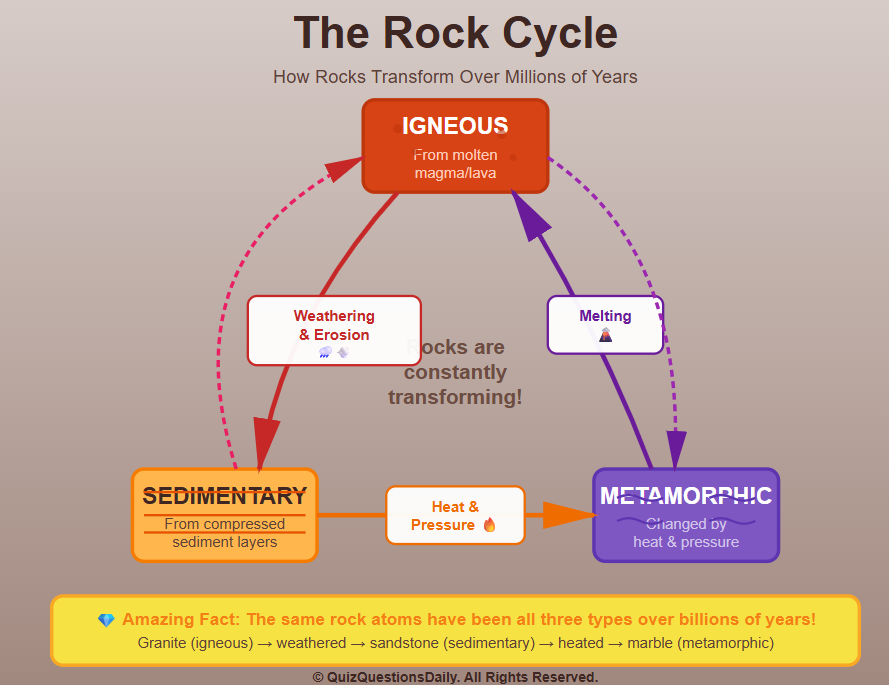
51. What are the three types of rocks? Igneous, sedimentary, and metamorphic
🪨 Fun Fact: The rock cycle means rocks are constantly transforming. Igneous rocks form from cooled lava/magma, sedimentary from compressed sediment, and metamorphic from rocks changed by heat and pressure. The same rock atoms might have been all three types over billions of years.
52. What is the outermost layer of Earth called? Crust
🌍 Fun Fact: Earth’s crust is incredibly thin compared to the planet’s size. If Earth were an apple, the crust would be thinner than the apple’s skin. The oceanic crust is only 3-5 miles thick, while continental crust averages 25 miles.
53. What causes earthquakes? Movement of tectonic plates along fault lines
🌊 Fun Fact: About 500,000 earthquakes occur worldwide each year, but only about 100 are strong enough to cause damage. The most powerful earthquake ever recorded was the 1960 Chile earthquake with a magnitude of 9.5. Japan experiences about 1,500 earthquakes annually.
54. What is the study of weather called? Meteorology
⛈️ Fun Fact: Despite its name, meteorology has nothing to do with meteors (I’m shocked too!) The term comes from Greek “meteoron” meaning “thing high up.” Ancient Greeks thought all weather phenomena, including meteors, occurred in the atmosphere.
55. What percentage of Earth’s surface is covered by water? Approximately 71%
💧 Fun Fact: About 96.5% of all Earth’s water is in the oceans, only 2.5% is freshwater! Of that freshwater, most is frozen in glaciers and polar ice caps. Only about 0.3% of all water on Earth is accessible freshwater in lakes and rivers. That’s why we need to conserve our water sources.
🚀 Round 6: Advanced Mixed Bag Science Quiz Questions
Ready to level up? These questions will challenge even the most knowledgeable science enthusiasts.
56. What is the Heisenberg Uncertainty Principle?
57. What is CRISPR?
58. What is dark matter?
59. What is the Second Law of Thermodynamics?
60. What is quantum entanglement?
61. What is the Krebs cycle?
62. What is superconductivity?
63. What is telomerase?
64. What is the difference between nuclear fission and fusion?
65. What is the Doppler Effect?
66. What are prions?
67. What is bioluminescence?
68. What is the photoelectric effect?
69. What is apoptosis?
70. What is the Hardy-Weinberg principle?
📊 Round 6 Advanced Mixed Bag Science Quiz Questions Complete! Check Your Answers:
56. What is the Heisenberg Uncertainty Principle? It is a fundamental principle in quantum mechanics stating that you cannot simultaneously know both the exact position and exact momentum of a particle with absolute precision.
🎯 Fun Fact: This isn’t about poor measurement tools, but rather it’s a fundamental property of reality. At quantum scales, the very act of measuring something changes it. Werner Heisenberg developed this in 1927 and won the Nobel Prize in 1932. This principle is why quantum computers are so powerful yet challenging to build.
Science Quiz Questions with Answers: CRISPR
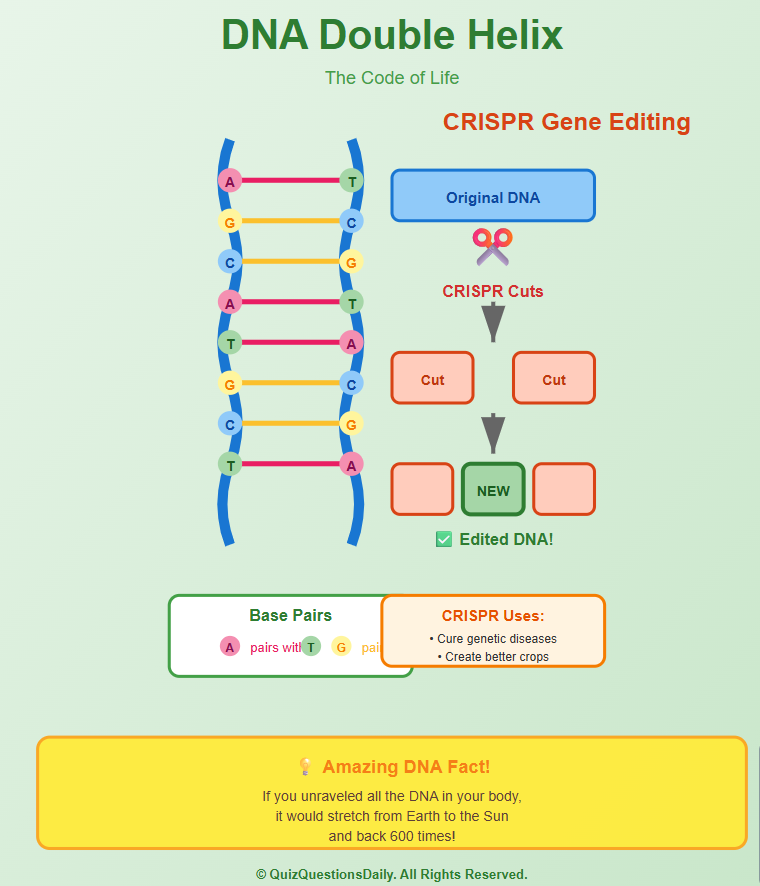
57. What is CRISPR? Clustered Regularly Interspaced Short Palindromic Repeats. This is a gene-editing technology that allows scientists to modify DNA sequences
✂️ Fun Fact: CRISPR was discovered in bacteria as a natural immune system. Scientists adapted this bacterial defense mechanism into a gene-editing tool. It’s so precise it’s been called “molecular scissors.” In 2020, its discoverers won the Nobel Prize. CRISPR could potentially cure genetic diseases, eliminate malaria, and even bring back extinct species (maybe we’ll live long enough to see Jurassic Park in real life)
58. What is dark matter? A form of matter that doesn’t emit, absorb, or reflect light, but is thought to make up about 27% of the universe’s mass-energy content
🌌 Fun Fact: We can’t see dark matter, but we know it exists because of its gravitational effects on visible matter. Without dark matter, galaxies would fly apart because there isn’t enough visible matter to hold them together. Dark matter literally makes up more of the universe than all the stars, planets, and gas combined.
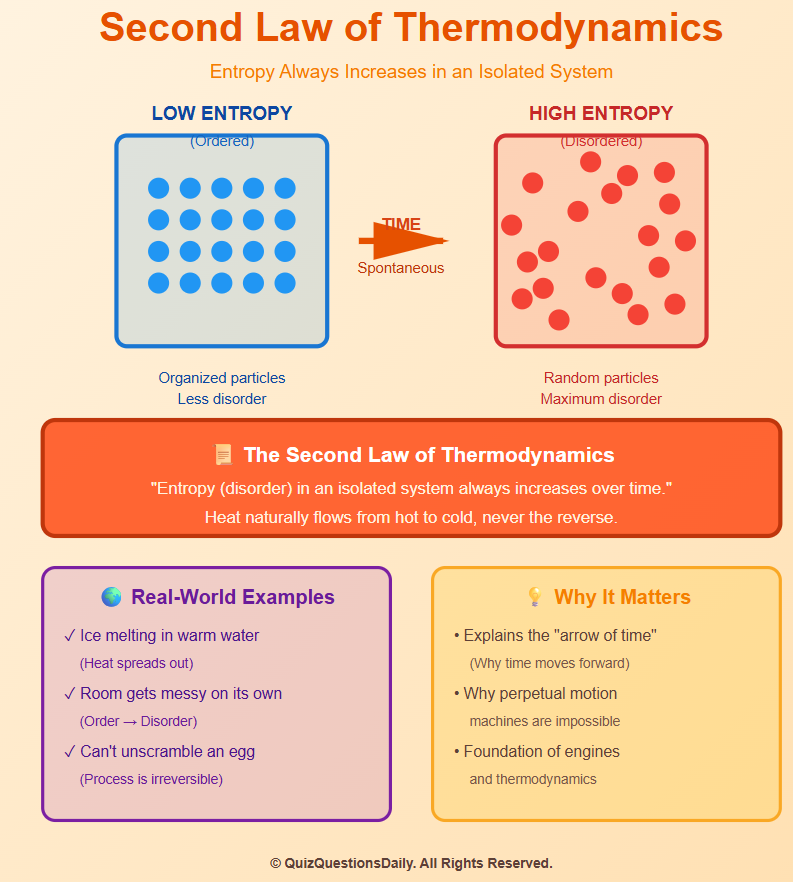
59. What is the Second Law of Thermodynamics? Entropy (disorder) in an isolated system always increases over time; heat cannot spontaneously flow from a colder body to a hotter body
🔥 Fun Fact: This law explains why you can’t unscramble an egg or why perpetual motion machines are impossible. It’s also why your room gets messy on its own but requires effort to clean. Some scientists say entropy explains the “arrow of time” which is why we remember the past but not the future.
Science Quiz Questions with Answers: 2nd Law of Thermodynamics
60. What is quantum entanglement? A phenomenon where particles become correlated in such a way that the quantum state of one particle cannot be described independently of the others, even when separated by large distances
👻 Fun Fact: Einstein famously called this “spooky action at a distance” because he found it so bizarre. When you measure one entangled particle, its partner instantly “knows” and changes state even if it’s on the other side of the galaxy. This doesn’t violate relativity because no information actually travels between them. It’s the foundation for quantum computing and quantum encryption.
61. What is the Krebs cycle? Also known as the citric acid cycle, it’s a series of chemical reactions used by aerobic organisms to generate energy through the oxidation of acetyl-CoA
⚡ Fun Fact: The Krebs cycle is happening in your mitochondria RIGHT NOW as you read this. It processes the food you eat into usable energy (ATP). Named after Hans Krebs who discovered it in 1937, this cycle is so crucial that it happens in nearly every living cell on Earth, from bacteria to blue whales.
62. What is superconductivity? A phenomenon where certain materials can conduct electricity with zero resistance at very low temperatures
🧊 Fun Fact: Superconductors are so efficient they can carry electrical current forever without losing energy. They also expel magnetic fields (Meissner effect), which allows magnets to levitate above them. This is how maglev trains work. The catch? Most superconductors only work at temperatures colder than -140°C.
63. What is telomerase? An enzyme that adds DNA sequences to telomeres (protective caps on chromosomes), playing a role in cellular aging and cancer
⏳ Fun Fact: Telomeres are like the plastic tips on shoelaces, in the sense that they protect chromosome ends from fraying. Every time a cell divides, telomeres get shorter. When they’re too short, the cell stops dividing (aging). Cancer cells activate telomerase to become “immortal.” Scientists are studying telomerase to understand aging and potentially extend healthy lifespan.
64. What is the difference between nuclear fission and fusion? Fission splits heavy atomic nuclei into lighter ones (releasing energy), while fusion combines light nuclei into heavier ones (releasing even more energy)
💥 Fun Fact: Fission powers current nuclear reactors and atomic bombs. Fusion powers the Sun and hydrogen bombs and could provide clean, nearly limitless energy if we can harness it. The Sun fuses 600 million tons of hydrogen every second. One kilogram of fusion fuel could produce as much energy as 10 million kilograms of coal.
65. What is the Doppler Effect? The change in frequency or wavelength of a wave in relation to an observer moving relative to the wave source
🚑 Fun Fact: This is why an ambulance siren sounds higher-pitched as it approaches you and lower as it moves away. The Doppler Effect works with all waves whether it’s sound, light, even water waves. Astronomers use it to detect exoplanets and measure how fast galaxies are moving away from us, proving the universe is expanding.
66. What are prions? Misfolded proteins that can induce other normal proteins to also misfold, causing diseases like Creutzfeldt-Jakob disease
🧬 Fun Fact: Prions are truly bizarre because they’re not alive, have no DNA or RNA, yet can “reproduce” by forcing other proteins to misfold. They cause Mad Cow Disease and are incredibly hard to destroy. They survive extreme heat, radiation, and most disinfectants. They won Stanley Prusiner the Nobel Prize in 1997 because they challenged everything we knew about infectious diseases.
Science Quiz Questions with Answers: Bioluminescence
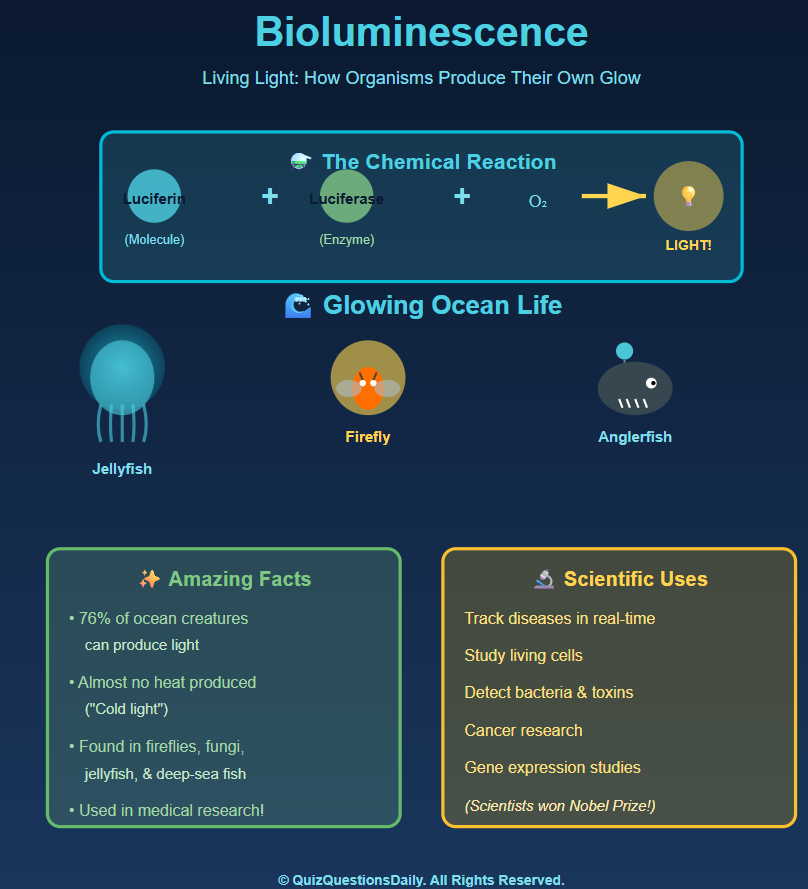
67. What is bioluminescence? The production and emission of light by living organisms through chemical reactions
✨ Fun Fact: About 76% of ocean creatures can produce their own light. Fireflies, some mushrooms, and even certain sharks are bioluminescent. The chemicals involved (luciferin and luciferase) are so efficient they produce almost no heat, they’re “cold light.” Scientists use bioluminescent proteins to track diseases and study living cells.
68. What is the photoelectric effect? The emission of electrons from a material when light of sufficient frequency shines on it (Einstein received the Nobel Prize for explaining this)
💡 Fun Fact: Einstein’s 1905 explanation of the photoelectric effect proved light behaves as particles (photons), not just waves. This was revolutionary and led to quantum mechanics. This effect is how solar panels generate electricity and how automatic doors sense when you approach. Ironically, Einstein won his Nobel Prize for this, not for relativity.
69. What is apoptosis? Programmed cell death which is a controlled process where cells self-destruct when damaged or no longer needed
💀 Fun Fact: Apoptosis is actually crucial for life. It’s how tadpoles lose their tails, how your fingers separated in the womb (they started as webbed), and how your immune system removes infected cells. Your body kills about 50-70 billion cells through apoptosis daily. Cancer is partially a failure of apoptosis, because they’re cells that should die, but don’t.
70. What is the Hardy-Weinberg principle? A principle stating that allele and genotype frequencies in a population will remain constant from generation to generation in the absence of evolutionary influences
📊 Fun Fact: This principle gives us a “null hypothesis” for evolution because it shows what happens when evolution ISN’T occurring. It assumes no mutation, no migration, random mating, large population, and no natural selection. Real populations never meet all these conditions, so the Hardy-Weinberg principle helps scientists detect and measure evolution in action.
🔬 Round 7: Latest Science Quiz Questions: Current Affairs 2025
Honestly, this is the section that I’m most excited about. I’ve gone through all of the current affairs related to science and tried to condense them to create this section. These current affairs science quiz questions cover the hottest topics in 2025.
71. What major achievement did the James Webb Space Telescope accomplish in early 2025?
72. Which country successfully landed a crewed mission on Mars in 2024?
73. What breakthrough in quantum computing was announced by Google in late 2024?
74. What new element was officially added to the periodic table in 2025?
75. What significant climate milestone was reached in 2024?
76. What major vaccine development was announced in 2024?
77. Which AI model achieved breakthrough performance in protein folding prediction in 2024?
78. What discovery was made about black holes in 2024?
79. What advancement in nuclear fusion was announced in 2024?
80. What new treatment for Alzheimer’s disease received approval in 2024?
81. What record did renewable energy achieve globally in 2024?
82. What discovery was made about Venus in 2024?
83. What breakthrough occurred in cancer treatment in 2024?
84. What achievement in space exploration did SpaceX accomplish in 2024?
85. What major finding about ocean health was reported in 2024?
📊 Round 7 Latest Science Quiz Questions: Current Affairs Complete! Check Your Answers
71. What major achievement did the James Webb Space Telescope accomplish in early 2025? Detection of potential biosignatures (signs of life) on exoplanet K2-18b through spectroscopy analysis
🔭 Fun Fact: K2-18b is 120 light-years away in the constellation Leo. The JWST detected dimethyl sulfide (DMS), a gas only produced by life on Earth. This doesn’t confirm alien life, but it’s the most promising biosignature ever found. The telescope costs around $10 billion and can see galaxies from 13.5 billion years ago.
72. Which country successfully landed a crewed mission on Mars in 2024? This is a trick question! No crewed Mars mission has occurred yet as of November 2025, though several nations have plans for the 2030s
🚀 Fun Fact: NASA’s Artemis program aims to return humans to the Moon first, then use it as a stepping stone to Mars by the late 2030s. SpaceX’s Starship is designed to carry around a 100 people to Mars. The journey would take 6-9 months each way. China, on the other hand, plans crewed Mars missions by 2033.
73. What breakthrough in quantum computing was announced by Google in late 2024? Achievement of “quantum advantage” with their Willow chip, which can perform certain calculations exponentially faster than classical supercomputers
💻 Fun Fact: Google’s Willow chip has 105 qubits and can solve problems in minutes that would take classical supercomputers 10 septillion years (longer than the universe’s age). Quantum computers could revolutionize drug discovery, artificial intelligence, and cryptography. They work by exploiting quantum superposition which means being in multiple states simultaneously.
74. What new element was officially added to the periodic table in 2025? No new elements were officially added in 2025; the periodic table remains at 118 confirmed elements
⚛️ Fun Fact: Elements 119 and 120 are actively being pursued by labs worldwide. Scientists are smashing atoms together at near-light speeds trying to create them. All elements beyond 94 (plutonium) don’t occur naturally and exist for only fractions of a second. Element 118 (oganesson) was officially named in 2016 and exists for just 0.7 milliseconds.
75. What significant climate milestone was reached in 2024? Global average temperatures exceeded 1.5°C above pre-industrial levels for the first time over a 12-month period
🌡️ Fun Fact: 2024 was the hottest year on record globally. The 1.5°C threshold was the target set by the Paris Agreement to avoid catastrophic climate impacts. Every fraction of a degree matters. Why so? The difference between 1.5°C and 2°C warming could affect hundreds of millions of people through droughts, floods, and sea-level rise!
76. What major vaccine development was announced in 2024? The first mRNA-based malaria vaccine showed over 75% efficacy in clinical trials
💉 Fun Fact: Malaria kills over 600,000 people annually, mostly children in Africa. This mRNA vaccine (like COVID vaccines) can be updated quickly for new malaria strains. Traditional malaria vaccine RTS,S took 30+ years to develop. mRNA technology is revolutionizing vaccine development. Scientists are now working on mRNA vaccines for cancer, HIV, and tuberculosis. What a time to be alive!
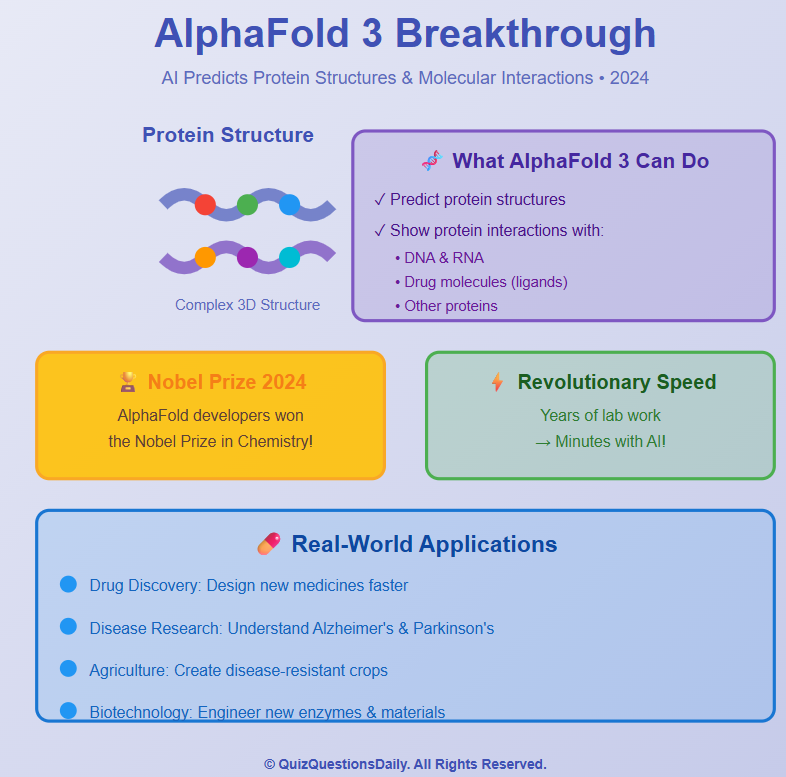
77. Which AI model achieved breakthrough performance in protein folding prediction in 2024? AlphaFold 3 by DeepMind, which can now predict protein interactions with other molecules
🧬 Fun Fact: AlphaFold 3 can predict structures of proteins, DNA, RNA, and ligands (drug molecules) interacting together. This is revolutionary for drug discovery. Previous versions won the Nobel Prize in Chemistry 2024. Understanding protein structures that took years in labs can now be predicted in minutes. This could accelerate cures for diseases like Alzheimer’s and Parkinson’s.
78. What discovery was made about black holes in 2024? Astronomers detected gravitational waves from the merger of two supermassive black holes, confirming theoretical predictions
🌀 Fun Fact: These black holes were billions of times the mass of our Sun and merged 9 billion light-years away. When they collided, they released more energy in gravitational waves than all the stars in the observable universe emit as light in the same time. The gravitational waves cause space-time itself to ripple like a pond.
79. What advancement in nuclear fusion was announced in 2024? Multiple fusion facilities achieved net energy gain, bringing commercial fusion power closer to reality
☀️ Fun Fact: Fusion could provide unlimited clean energy with no carbon emissions. The fuel (deuterium and tritium) can be extracted from seawater. One glass of seawater contains enough fusion fuel to equal 300 liters of gasoline. The challenge is containing plasma at 100 million°C which is way hotter than the Sun’s core. Hopefully, commercial fusion power might be available by 2035-2040.
80. What new treatment for Alzheimer’s disease received approval in 2024? Lecanemab (Leqembi) became the first fully approved drug to slow cognitive decline in early Alzheimer’s
🧠 Fun Fact: Over 55 million people worldwide have dementia, with Alzheimer’s being the most common form. Lecanemab targets amyloid plaques in the brain. It’s not a cure but can slow progression by 27% in early stages. This is the first treatment that actually slows the disease, not just symptoms. Researchers are now optimistic about eventually preventing Alzheimer’s entirely.
81. What record did renewable energy achieve globally in 2024? Renewable energy sources exceeded 30% of global electricity generation for the first time
🌍 Fun Fact: Solar power alone grew by 400 gigawatts in 2024 which is enough to power 100 million homes. China installed more solar panels in 2023 than the entire world did in 2022. Wind and solar are now the cheapest forms of new electricity in most countries. By 2030, renewables could provide 50% of global electricity.
82. What discovery was made about Venus in 2024? Evidence of active volcanoes on Venus was confirmed through surface heat signatures detected by orbital probes
🌋 Fun Fact: Venus is Earth’s “evil twin”. They are similar size but Venus has a surface temperature hot enough to melt lead (462°C/864°F). The atmospheric pressure is 92 times Earth’s which is like being 900 meters underwater. These active volcanoes might explain Venus’s thick CO₂ atmosphere. Some scientists think Venus once had oceans like Earth before a runaway greenhouse effect.
83. What breakthrough occurred in cancer treatment in 2024? CAR T-cell therapy showed remarkable success in treating solid tumors, not just blood cancers
🎗️ Fun Fact: CAR T-cell therapy genetically engineers your own immune cells to hunt cancer. It’s like turning your immune system into a guided missile. Previously, it only worked well against blood cancers like leukemia. Success with solid tumors (breast, lung, colon cancer) is a real game-changer. Some patients with terminal cancer have achieved complete remission.
84. What achievement in space exploration did SpaceX accomplish in 2024? Successful completion of the first civilian spacewalk during the Polaris Dawn mission
👨🚀 Fun Fact: Jared Isaacman and Sarah Gillis performed this spacewalk at 700 km altitude which is higher than any spacewalk since Apollo. They tested SpaceX’s new EVA suits designed for future Moon and Mars missions. Only about 250 government astronauts had spacewalked before this. This opens spacewalking to private citizens and paves the way for commercial space stations.
85. What major finding about ocean health was reported in 2024? Discovery that deep ocean ecosystems are warming faster than previously thought, threatening marine biodiversity
🌊 Fun Fact: The deep ocean (below 1,000 meters) holds 90% of Earth’s heat capacity and absorbs about 25% of human CO₂ emissions. Deep-sea ecosystems evolved in stable cold temperatures for millions of years. Even small temperature changes (0.5-1°C) devastate these creatures.
⚛️ Round 8: Astronomy and Space Science Quiz Questions
86. What happens to astronauts’ height in space?
87. What color is sunset on Mars?
88. What planet has the most moons?
89. What is the name of the first human-made object to leave our solar system?
90. Can you cry in space?
📊 Round 8 Astronomy and Space Science Quiz Questions Complete! Check Your Answers
86. What happens to astronauts’ height in space? They grow taller by 2-3 inches (5-8 cm) because the spine expands without gravity compressing it
🚀 Fun Fact: Astronauts actually have to bring two sizes of spacesuits. The height gain is temporary and they shrink back to normal within days of returning to Earth. This spine expansion can be painful and causes back problems. Sleeping bags in space need to accommodate the extra height. Some astronauts have grown up to 3% taller in space.
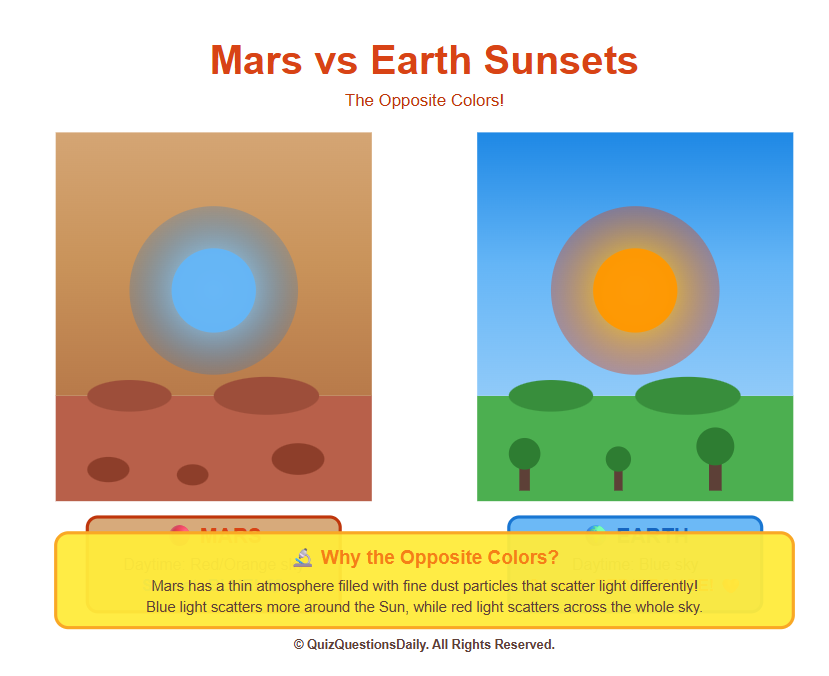
87. What color is sunset on Mars? Blue (opposite of Earth’s red/orange sunsets)
🔵 Fun Fact: Mars has red skies during the day but blue sunsets which is the exact opposite of Earth. This happens because Mars’s atmosphere is thin and filled with fine dust particles that scatter light differently. The Curiosity and Perseverance rovers have captured stunning photos of blue Martian sunsets. During dust storms, the entire Martian sky can turn butterscotch pink.
88. What planet has the most moons? Saturn (with 146 confirmed moons as of 2024)
🪐 Fun Fact: Saturn used to be tied with Jupiter, but scientists keep discovering more. Its largest moon, Titan, is bigger than the planet Mercury and has lakes of liquid methane. Some moons are tiny, only a few kilometers across. Saturn’s moon Enceladus shoots geysers of water ice into space. One of Saturn’s moons (Iapetus) looks like the Death Star from Star Wars due to a mysterious ridge around its equator.
89. What is the name of the first human-made object to leave our solar system? Voyager 1 (launched in 1977, left the solar system in 2012)
🛸 Fun Fact: Voyager 1 is now over 15 billion miles from Earth and still sending signals. It carries a golden record with sounds and images from Earth including greetings in 55 languages, music from Mozart and Chuck Berry, and even whale songs. Its twin, Voyager 2, left the solar system in 2018.
90. Can you cry in space? Yes, but tears don’t fall. Instead, they form a bubble around your eyes due to lack of gravity
😢 Fun Fact: Astronaut Chris Hadfield demonstrated this in space. Tears just stick to your face in a watery blob and can sting your eyes. You have to wipe them away manually. Without gravity, tears can’t drain through tear ducts normally. This same principle affects many bodily functions. Astronauts can’t burp properly, and sneezing is problematic because droplets float away.
🐻 Round 9: Environmental Science Quiz Questions
91. What is the most abundant gas in Earth’s atmosphere?
92. What animal can survive in space without any protection?
93. How much of the ocean have humans explored?
94. What is the fastest animal on Earth?
95. What percentage of species that have ever existed on Earth are now extinct?
📊 Round 9 Environmental Science Quiz Questions Complete! Check Your Answers
91. What is the most abundant gas in Earth’s atmosphere? Nitrogen (about 78%)
🌬️ Fun Fact: Even though we breathe constantly, we don’t use the nitrogen we inhale, it just goes in and out. Oxygen is only 21% of air. Nitrogen is essential for life but plants can’t use atmospheric nitrogen directly.
92. What animal can survive in space without any protection? Tardigrades (water bears)
🐻 Fun Fact: These microscopic creatures survived 10 days exposed to the vacuum of space. Tardigrades can withstand temperatures from -272°C to 150°C, pressure 6 times deeper than the deepest ocean, and 1,000 times more radiation than humans. They can survive 30 years without food or water by entering a “tun” state. Scientists even found them living in Antarctic ice and volcanic vents.
93. How much of the ocean have humans explored? Less than 5% (some estimates say less than 10%)
🌊 Fun Fact: We’ve mapped more of Mars’s surface than Earth’s ocean floor. The ocean contains 99% of Earth’s living space. Yet more people have been to space than to the deepest part of the ocean (Mariana Trench).
94. What is the fastest animal on Earth? Peregrine falcon (diving speeds over 240 mph / 386 km/h)
🦅 Fun Fact: When hunting, peregrine falcons dive (called a “stoop”) at speeds that would kill most animals from the air pressure alone. They have specialized nostrils to regulate breathing at high speeds and a third eyelid to protect their eyes.
95. What percentage of species that have ever existed on Earth are now extinct? Over 99% (99.9% of all species are extinct)
💀 Fun Fact: Earth has experienced 5 major mass extinction events. The biggest (Permian extinction 252 million years ago) killed 96% of marine species and 70% of land species. The dinosaur extinction 66 million years ago was caused by an asteroid. Scientists warn we’re now in a 6th mass extinction caused by humans.
🦴 Round 10: Human Anatomy and Medicine Science Quiz Questions
96. What is the only part of the human body that cannot heal itself?
97. How fast does a sneeze travel?
98. What is the strongest bone in the human body?
99. What percentage of the human brain is water?
100. How many taste buds does the average human tongue have?
📊 Round 10 Human Anatomy and Medicine Quiz Questions Complete! Check Your Answers
96. What is the only part of the human body that cannot heal itself? Tooth enamel
🦷 Fun Fact: Once tooth enamel is damaged, it’s gone forever. Enamel is the hardest substance in your body, even harder than bone. But it has no living cells, so it can’t regenerate. That’s why dentists fill cavities instead of waiting for teeth to heal.
97. How fast does a sneeze travel? Up to 100 miles per hour (160 km/h)
🤧 Fun Fact: Sneezes can spray up to 40,000 droplets that travel up to 26 feet. That’s why you should sneeze into your elbow. Also another quick fact, the “achoo” sound varies by culture. In Japan it sounds like “hakushon,” in Korean “achee.”
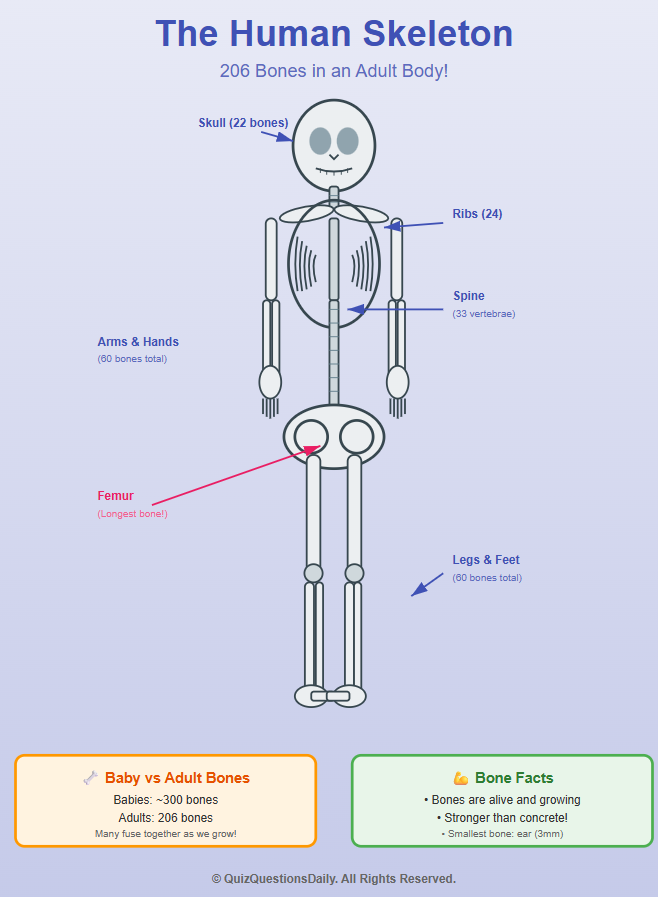
Science Quiz Questions with Answers: Human Body
98. What is the strongest bone in the human body? The femur (thigh bone)
🦴 Fun Fact: Your femur can support 30 times your body weight before breaking. It’s stronger than concrete of the same weight. The femur is also the longest bone, about 1/4 of your height. In car accidents, it takes tremendous force to break a femur.
99. What percentage of the human brain is water? About 73% water
💧 Fun Fact: Your brain is basically a spongy water balloon. Dehydration of just 2% can impair attention, memory, and cognitive skills. That’s why you get headaches when dehydrated, so remember to take a sip of water regularly.
100. How many taste buds does the average human tongue have? About 10,000 taste buds (between 2,000-10,000)
👅 Fun Fact: You replace your taste buds every 1-2 weeks. As you age, you lose taste buds. Elderly people may have only 5,000. Kids have more taste buds than adults, making them “supertasters” (that’s partly why they’re picky eaters, take that mom!)
❓Science Quiz Questions FAQ
- What are good science quiz questions for kids?
Good science quiz questions for kids should be age-appropriate, engaging, clear, educational and fun! You can try out our top 20 questions in the “Easy Science Quiz Questions for Kids” section are perfect for ages 6-12 and cover basic biology, physics, and earth science.
- Where can I find the latest science quiz questions?
For the most current science quiz questions, you can check our “Latest Science Quiz Questions – Current Affairs 2025” section above. For more questions, follow NASA, Nature, and Science Magazine for breaking discoveries and monitor Nobel Prize announcements. You can even subscribe to science news aggregators.
- How do I download science quiz questions as a PDF?
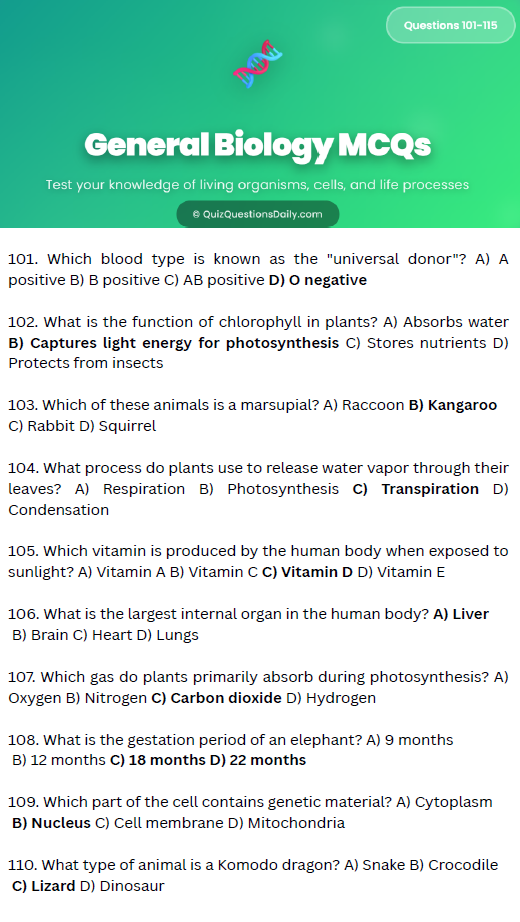
Page 1 of PDF
Simply scroll to our “Download Free 100 extra Science Quiz Questions PDF” section and click the download button. No email is required. The PDF includes additional 100 questions organized by category, complete answer key with explanations.
- How many science quiz questions should I include in a quiz competition?
Recommended science quiz question counts:
- Quick classroom quiz: 10-15 questions (10-15 minutes)
- Weekly test: 20-30 questions (25-35 minutes)
- Quiz night/competition: 40-60 questions (45-75 minutes)
- Comprehensive exam: 80-100 questions (90-120 minutes)
Rule of thumb: Allow 60-90 seconds per question, including time for answer recording and transitions.
100 Science Quiz Questions with Answers PDF
Looking for more questions? I’ve complied a set of another 100 questions in an easy multiple choice format that you can just download and use it for your next quiz night or a quick way to spend some time to refresh your science knowledge. And the best part? It’s free!
What Now?
Now that you’ve gone through everything, take a breather and make a few sips of water. There’s always something new when it comes to science, so it’s totally alright if you got something wrong. It’s better instead to try to find out more because that’s the actual spirit of learning. So don’t forget to check out the other quizzes on the site because we’ve got some pretty amazing ones out there! See you on the next one.